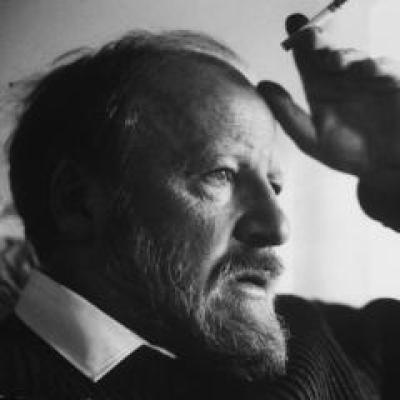
Serve you right if something did get you, you useless lot of cry-babies!
Novelists do not write as birds sing, by the push of nature. It is part of the job that there should be much routine and some daily stuff on the level of carpentry.
When you take a child who's hollering like hell, sit him on your knee, and say "once upon a time", you stop him hollering. As long as you go on telling him a story, he will listen. Novelists who neglect this fundamental effect do so at their peril. They become what is known as the experimental novelist, and an experimental novel is not really a novel at all.
I suppose I'd have to say that my favourite author is Homer. After Homer's Ilaid, I'd name The Odyssey, and then I'd mention a number of plays of Euripides.
We just got to go on, that's all. That's what grownups would do.
It is at least scientifically respectable to postulate that at the centre of a black hole the laws of nature no longer apply. Since most scientists are just a bit religious and most religious are seldom wholly unscientific we find humanity in a comical position. His scientific intellect believes in the possibility of miracles inside a black hole while his religious intellect believes in them outside it.
Ralph... would treat the day's decisions as though he were playing chess. The only trouble was that he would never be a very good chess player.
Language fits over experience like a straight-jacket.
The writer probably knows what he meant when he wrote a book, but he should immediately forget what he meant when he's written it.
You have the older generation like Iris Murdoch and Angus Wilson who are not as old as Graham Greene, but still are coming on. I dare say anyone who knew the scene better than I know it could fill it in with a very satisfactory supply of novels.
I have a confession to make. The love affair of my life has been with the Greek language. I have now reached the age when it has occurred to me that I may have read some books for the last time. I suddenly thought that there are books I cannot bear not to read again before I die. One that stands out a mile is Homer's Iliad.
Heaven lies around us in our infancy.
There is, they say, no fool like an old fool.
For a small island [Great Britain], the place is remarkably diverse.
I think women are foolish to pretend they are equal to men, they are far superior and always have been.
However you disguise novels, they are always biographies.
The skull regarded Ralph like one who knows all the answers and won't tell.
I began to see what people were capable of doing. Anyone who moved through those years without understanding that man produces evil as a bee produces honey, must have been blind or wrong in the head.
There were no words, and no movements but the tearing of teeth and claws.
The world, that understandable and lawful world, was slipping away.
His mind was crowded with memories; memories of the knowledge that had come to them when they closed in on the struggling pig, knowledge that they had outwitted a living thing, imposed their will upon it, taken away its life like a long satisfying drink.
We're not savages. We're English.
I am astonished at the ease with which uninformed persons come to a settled, a passionate opinion when they have no grounds for judgment.
Philosophy and Religion-what are they when the wind blows and the water gets up in lumps?
One tries to tell a truth, and one hopes that the truth has a general application rather than just a specific one.
We did everything adults would do. What went wrong?
As soon as Oliver Twist is serialized, people who would never dream of reading [Charles] Dickens, if they hadn't seen him on their box, buy the paperback.
What a man does defiles him, not what is done by others.
The man who tells the tale if he has a tale worth telling will know exactly what he is about and this business of the artist as a sort of starry-eyed inspired creature, dancing along, with his feet two or three feet above the surface of the earth, not really knowing what sort of prints he's leaving behind him, is nothing like the truth.
The pile of guts was a black blob of flies that buzzed like a saw. After a while these flies found Simon. Gorged, they alighted by his runnels of sweat and drank. They tickled under his nostrils and played leapfrog on his thighs. They were black and iridescent green and without number; and in front of Simon, the Lord of the Flies hung on his stick and grinned. At last Simon gave up and looked back; saw the white teeth and dim eyes, the blood—and his gaze was held by that ancient, inescapable recognition.
One's intelligence may march about and about a problem, but the solution does not come gradually into view. One moment it is not. The next it is there.
Which is better -- to be a pack of painted Indians like you are, or to be sensible like Ralph is? Which is better -- to have rules and agree, or to hunt and kill? Which is better, law and rescue, or hunting and breaking things up?
I am here; and here is nowhere in particular.
Percival was mouse-coloured and had not been very attractive even to his mother.
Experimental novels are sometimes terribly clever and very seldom read. But the story that appeals to the child sitting on your knee is the one that satisfies the curiosity we all have about what happened then, and then, and then. This is the final restriction put on the technique of telling a story. A basic thing called story is built into the human condition. It's what we are; it's something to which we react.
The Navy's a very gentlemanly business. You fire at the horizon to sink a ship and then you pull people out of the water and say, 'Frightfully sorry, old chap.'
The greatest pleasure is not - say - sex or geometry. It is just understanding. And if you can get people to understand their own humanity - well, that's the job of the writer.
Worse than madness. Sanity.
Nothing is so impenetrable as laughter in a language you don't understand.
There's a kinship among men who have sat by a dying fire and measured the worth of their life by it.
Utopias are presented for our inspection as a critique of the human state. If they are to be treated as anything but trivial exercises of the imagination. I suggest there is a simple test we can apply. We must forget the whole paraphernalia of social description, demonstration, expostulation, approbation, condemnation. We have to say to ourselves, How would I myself live in this proposed society? How long would it be before I went stark staring mad?
Consider a man riding a bicycle. Whoever he is, we can say three things about him. We know he got on the bicycle and started to move. We know that at some point he will stop and get off. Most important of all, we know that if at any point between the beginning and the end of his journey he stops moving and does not get off the bicycle he will fall off it. That is a metaphor for the journey through life of any living thing, and I think of any society of living things.
You'll get back to where you came from.
Which is better--to have laws and agree, or to hunt and kill?
This is our island. It's a good island. Until the grownups come to fetch us we'll have fun.
I'm scared of him," said Piggy, "and that's why I know him. If you're scared of someone you hate him but you can't stop thinking about him. You kid yourself he's all right really, an' then when you see him again; it's like asthma an' you can't breathe.
Of the authors writing in English, I'd mention Shakespeare and Milton. But all this is terribly high-hat and makes me sound very po-faced, I'm afraid; however, I just happen to like these enormous, swinging, great creatures.
the conch exploded into a thousand white fragments and ceased to exist.
How would I myself live in this proposed society? How long would it be before I went stark staring mad?
The mask was a thing on it's own, behind which Jack hid, liberated from shame and self-conciousness.
At the moment of vision, the eyes see nothing.
He found himself understanding the wearisomeness of this life,where every path was an improvisation and a considerable part of one's waking life was spent watching one's feet.
I play the piano passionately and inaccurately. Indeed, I worked out the other day that of my seventy-five years; I have spent at least one year sitting on a piano stool.
I hope my books make statements about our general condition.
Put simply the novel stands between us and the hardening concept of statistical man. There is no other medium in which we can live for so long and so intimately with a character. That is the service a novel renders.
Ralph wept for the end of innocence, the darkness of man's heart, and the fall through the air of the true, wise friend called Piggy.
I've come across a novel called The Palm-Wine Drinkard, by the Nigerian writer Amos Tutuola, that is really remarkable because it is a kind of fantasy of West African mythology all told in West African English which, of course, is not the same as standard English.
We've got to have rules and obey them. After all, we're not savages. We're English, and the English are best at everything.
The trouble was, if you were a chief you had to think, you had to be wise.
The greatest ideas are the simplest.
Simon became inarticulate in his effort to express mankind's essential illness.
I don't think they [contemporary writers] read me either. I mean, if we're concerned genuinely with writing, I think we probably get on with our work.
My yesterdays walk with me. They keep step, they are gray faces that peer over my shoulder.
If faces were different when lit from above or below -- what was a face? What was anything?
Maybe there is a beast… maybe it's only us.
I know there isn't no beast—not with claws and all that, I mean—but I know there isn't no fear, either." Piggy paused. "Unless—" Ralph moved restlessly. "Unless what?" "Unless we get frightened of people.
He became absorbed beyond mere happiness as he felt himself exercising control over living things. He talked to them, urging them, ordering them. Driven back by the tide, his footprints became bays in which they were trapped and gave him the illusion of mastery.
I am by nature an optimist and by intellectual conviction a pessimist.
He doesn't mind if he dies... indeed, he would like to die; but yet he fears to fall. He would welcome a long sleep; but not at the price of falling to it.
Childhood is a disease - a sickness that you grow out of.
Sleep is when all the unsorted stuff comes flying out as from a dustbin upset in a high wind.
I mean, if we're concerned genuinely with writing, I think we probably get on with our work. I think this is very true of English writers, but perhaps not so true of French writers, who seem to read each other passionately, extensively, and endlessly, and who then talk about it to each other - which is splendid.
Beethoven for listening; Liszt, Chopin, and Beethoven for playing as well as Bach and Prokofiev and so on. If I kept going, this list would spiral. It's as wide as literature; in fact, it is probably wider.
Among the virtues and vices that make up the British character, we have one vice, at least, that Americans ought to view with sympathy. For they appear to be the only people who share it with us. I mean our worship of the antique. I do not refer to beauty or even historical association. I refer to age, to a quantity of years.
People don't help much.
The beast was harmless and horrible; and the news must reach the others as soon as possible.
I'm not a critic so much of my own writing. People must make up their own minds over that.
Which is better, law and rescue, or hunting and breaking things up?
Roger stooped, picked up a stone, aimed and threw it at Henry-threw it to miss. The stone, that token of preposterous time, bounced five yards to Henry's right and fell in the water. Roger gathered a handful of stones and began to throw them. Yet there was a space round Henry, perhaps six yards in diameter, into which he dare not throw. Here, invisible yet strong, was the taboo of the old life. Round the squatting child was the protection of parents and school and policemen and the law. Roger was conditioned by a civilization that knew nothing of him and was in ruins.
Life's scientific, but we don't know, do we? Not certainly, I mean.
Together, joined in effort by the burden, they staggered up the last steep of the mountain. Together, they chanted One! Two! Three! and crashed the log on to the great pile. Then they stepped back, laughing with triumphant pleasure.
I do like people to read the books twice, because I write my novels about ideas which concern me deeply and I think are important, and therefore I want people to take them seriously. And to read it twice of course is taking it seriously.
What are we? Humans? Or animals? Or savages?
No human endeavour can ever be wholly good... it must always have a cost.
The thing is - fear can't hurt you any more than a dream.
Kill the pig! Cut his throat! Kill the pig! Bash him in!
A crowd of grade-three thinkers, all shouting the same thing, all warming their hands at the fire of their own prejudices, will not thank you for pointing out the contradictions in their beliefs. Man is a gregarious animal, and enjoys agreement as cows will graze all the same way on the side of a hill.
The candle-buds opened their wide white flowers....Their scent spilled out into the air and took possession of the island.
I really feel the novel has certain conveniences about it and has something so fundamental about it you could almost say that as long as there is paper, there is going to be the novel.
How can you expect to be rescued if you don’t put first things first and act proper?
Every novel is a biography. Well, then, this is a novel [The Paper Men] which is a biography that is pretending to be an autobiography. That's what you could say about it.
Towards midnight the rain ceased and the clouds drifted away, so that the sky was scattered once more with the incredible lamps of stars.
I wouldn't have thought that the techniques of story-telling, which is what the novel is after all, can vary much because there are two things involved.There's a story and there's a listener, whose attention you have to keep. Now the only way in which you can keep a reader's attention to a story is in his wanting to know what is going to happen next. This puts a fairly close restriction on the method you must use.
To be in a world which is a hell, to be of that world and neither to believe in or guess at anything but that world is not merely hell but the only possible damnation: the act of a man damning himself. It may be
What kind of human person has a favorite eraser?
Honestly, I haven't the time to read contemporary writers. I know this is awful, but in the main it is true.
Graham Greene at 82 years old was still writing, and I don't think anyone can deny the force, the expertise, and the unique quality of his writing, if you take his complete oeuvre.
I do think that art that doesn't communicate is useless.
In India the odd thing is that English is this almost artificial language floating on the surface of a place with about fifty other languages. The same is true of Nigeria but even more so.
Life should serve up its feast of experience in a series of courses.
Are we savages or what?
The rules!" shouted Ralph, "you're breaking the rules!" "Who cares?
Before the Second World War I believed in the perfectibility of social man; that a correct structure of society would produce goodwill; and that therefore you could remove all social ills by a reorganisation of society. .... but after the war I did not because I was unable to. I had discovered what one man could do to another... I must say that anyone who moved through those years without understanding that man produces evil as a bee produces honey, must have been blind or wrong in the head...
I am not a theologian or a philosopher. I am a story teller.
We're all mad, the whole damned race. We're wrapped in illusions, delusions, confusions about the penetrability of partitions, we're all mad and in solitary confinement.
Biography always has fulfiled this role. Robinson Crusoe is a biography, as is Tom Jones. You can go through the whole range of the novel, and you will find it is biography. The only difference between one example and the other is that sometimes it's a partial biography and sometimes it's a total biography. Clarissa, for example, is a partial biography of Clarissa and a partial biography of Lovelace. In other words, it doesn't follow Lovelace from when he is in the cradle, though it takes him to the grave.
Only one novel is a novel: that is a successful novel.
But forgiveness must not only be given but received also.
It wasn't until I was 37 that I grasped the great truth that you've got to write your own books and nobody else's, and then everything followed from there.
I began to write when I was seven, and I have been writing off and on ever since. It is still off and on. You can say that when I am on, when I know I have a book which I am going to write, then I write two thousand words a day. That's so many pages longhand.
We have a disharmony in our natures. We cannot live together without injuring each other.
Fancy thinking the Beast was something you could hunt and kill! You knew, didn’t you? I’m part of you? Close, close, close! I’m the reason why it’s no go? Why things are what they are?
He lost himself in a maze of thoughts that were rendered vague by his lack of words to express them. Frowning, he tried again.
I will tell you what man is. He is a freak, an ejected foetus robbed of his natural development, thrown out into the world with a naked covering of parchment, with too little room for his teeth and a soft bulging skull like a bubble. But nature stirs a pudding there.
One thing should be put firmly. Where people have commented on that novel [The Paper Men], they generally criticize the poor academic, Rick L. Tucker, who is savaged by the author, Wilfred Barclay. I don't think people have noticed that I have been far ruder about Barclay than I have been about Tucker. Tucker is a fool, but Barclay is a swine. The author really gets his come-uppance.
Even if you got rid of paper, you would still have story-tellers. In fact, you had the story-tellers before you had the paper.
They walked along, two continents of experience and feeling unable to communicate.
Maybe, he said hesitantly, maybe there is a beast. The assembly cried out savagely and Ralph stood up in amazement. You, Simon? You believe in this? I don't know, said Simon. His heartbeats were choking him. [...] Ralph shouted. Hear him! He's got the conch! What I mean is . . . maybe it's only us. Nuts! That was from Piggy, shocked out of decorum.
He who rides the sea of the Nile must have sails woven of patience.
It may be -- I hope it is -- redemption to guess and perhaps perceive that the universe, the hell which we see for all its beauty, vastness, majesty, is only part of a whole which is quite unimaginable.
I believe man suffers from an appalling ignorance of his own nature. I produce my own view in the belief that it may be something like the truth.
Art is partly communication, but only partly. The rest is discovery.
An orotundity, which I define as Nobelitis a pomposity in which one is treated as representative of more than oneself by someone conscious of representing more than himself.
While I am on, I can discipline myself to that extent. When I am off, I can't discipline myself at all. On the other hand, when I am off, there are so many things I like doing, it doesn't really matter.
Marx, Darwin and Freud are the three most crashing bores of the Western World. Simplistic popularization of their ideas has thrust our world into a mental straitjacket from which we can only escape by the most anarchic violence.