Despair shows us the limit of our imagination. Imaginations shared create collaboration, collaboration creates community, and community inspires social change.
Finding beauty in a broken world is creating beauty in the world we find.
An individual doesn't get cancer, a family does.
When you look at the Pueblo communities along the Rio Grande, when you talk to the Navajo people, the Ute people, and certainly the native peoples of California who still have their communities intact, it is what they have always known: that we are not apart from nature but a part of it.
If you take away all the prairie dogs, there will be no one to cry for the rain.
The world is holy. We are holy. All life is holy. Daily prayers are delivered on the lips of breaking waves, the whisperings of grasses, the shimmering of leaves.
I think the whole idea of home is central to who we are as human beings.
Once upon a time, when women were birds, there was the simple understanding that to sing at dawn, and to sing at dusk, was to heal the world through joy. The birds still remember what we have forgotten, that the world is meant to be celebrated.
John Lilly suggests whales are a culture maintained by oral traditions. Stories. The experience of an individual whale is valuable to the survival of its community. I think of my family stories-Mother's in particular-how much I need them now, how much I will need them later. It has been said when an individual dies, whole worlds die with them. The same could be said of each passing whale.
What is the most important thing one learns in school? Self-esteem, support, and friendship.
To be whole. To be complete. Wildness reminds us what it means to be human, what we are connected to rather than what we are separate from.
The human heart is the first home of democracy.
Our sense of community and compassionate intelligence must be extended to all life forms, plants, animals, rocks, rivers, and human beings. This is the story of our past and it will be the story of our future.
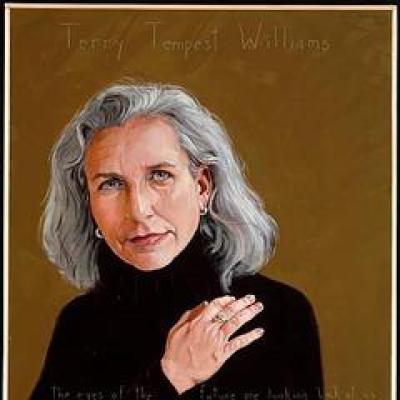
The Eyes of the Future are looking back at us and they are praying for us to see beyond our own time.
I write from the place of inquiry. The first draft is a discovery period to see what I know and what I don't know. My task is simply to follow the words. There are surprises along the way. I just have to get it down. Call it the sculptor's clay.
I can tell that the Greater Yellowstone from the Tetons, to the Lamar Valley where wolves howl and grizzlies roam, acts as my spine, my range of memory that ties me to landscape of Other. And that the ocean from the rocky coast of Maine, to the Florida everglades, to the looming cliffs at Big Sur, sustain me, remind me we are nothing without salt water, wind, and waves.
Agitation gives birth to creation.
Downwinders, meaning those people, individuals, communities that were downwind of the nuclear test site. During those years when we were testing atomic bombs above ground, when we watched them for entertainment from the roofs of our high schools, little did we know what was raining down on us, little did we know what would appear years later.
This is my living faith, an active faith, a faith of verbs: to question, explore, experiment, experience, walk, run, dance, play, eat, love, learn, dare, taste, touch, smell, listen, speak, write, read, draw, provoke, emote, scream, sin, repent, cry, kneel, pray, bow, rise, stand, look, laugh, cajole, create, confront, confound, walk back, walk forward, circle, hide, and seek.
A mother and daughter are an edge. Edges are ecotones, transitional zones, places of danger or opportunity. House-dwelling tension. When I stand on the edge of the land and sea, I feel this tension, this fluid line of transition. High tide. Low tide. It is the sea's reach and retreat that reminds me we have been human for only a very short time.
Storytelling awakens us to that which is real. Honest. . . . it transcends the individual. . . . Those things that are most personal are most general, and are, in turn, most trusted. Stories bind. . . . They are basic to who we are. A story composite personality which grows out of its community. It maintains a stability within that community, providing common knowledge as to how things are, how things should be -- knowledge based on experience. These stories become the conscience of the group. They belong to everyone.
If you know wilderness in the way that you know love, you would be unwilling to let it go.... This is the story of our past and it will be the story of our future.
I admire how she protects her energy and understands her limitations.
Stories have the power to create social change and inspire community.
How do we take our anger and transform it into sacred rage? How do we create a language that opens the heart instead of closing it? To bear witness is not a passive act. It's an act of consequence that leads to consciousness. It matters. I am curious. I want to know why. I was raised with a scripture that says, "The glory of God is intelligence." And to me our greatest intelligence is following our instincts, trusting our intuition.
I truly believe that to stay home, to learn the names of things, to realize who we live among . . . then I believe a politics of place emerges where we are deeply accountable to our communities, to our neighborhoods, to our home . . . If we are not rooted deeply in place, making that commitment to dig in and stay put . . . then I think we are living a life without specificity, and then our lives become abstractions. Then we enter a place of true desolation.
To slow down is to be taken into the soul of things.
But, today, the idea of faith returns to me. Faith defies logic and propels us beyond hope because it is not attached to our desires. Faith is the centerpiece of a connected life. It allows us to live by the grace of invisible strands. It is a belief in a wisdom superior to our own. Faith becomes a teacher in the absence of fact.
To withhold words is power. But to share our words with others, openly and honestly, is also power.
There is an art to writing, and it is not always disclosure. The act itself can be beautiful, revelatory, and private.
Wherever we are, we can call for and create these kinds of settings for authentic dialogue. This is the seedbed of social change. In a voiced community, we all flourish. But it's not easy. Revolutionary patience and persistence is required. It can be messy, it is unpredictable, and change, especially structural change takes time - time and leadership and the will of an engaged community. What is needed? In a word, courage.
I still have great faith in democracy. I have great belief in the power of community.
I take a deep breath and sidestep my fear and begin speaking from the place where beauty and bravery meet--within the chambers of a quivering heart.
I think our lack of intimacy with the land has initiated a lack of intimacy with each other. What we perceive as non- human, outside of us, is actually in direct relationship with us.
Our kinship with Earth must be maintained; otherwise, we will find ourselves trapped in the center of our own paved-over souls with no way out.
There are two important days in a woman's life: the day she is born and the day she finds out why.
When you are with a landscape or a human being where there is no need to speak, but simply to listen, to perceive, to feel.
It's strange how deserts turn us into believers. I believe in walking in a landscape of mirages, because you learn humility. I believe in living in a land of little water because life is drawn together. And I believe in the gathering of bones as a testament to spirits that have moved on. If the desert is holy, it is because it is a forgotten place that allows us to remember the sacred. Perhaps that is why every pilgrimage to the desert is a pilgrimage to the self.
I believe the personal is the collective. One of the ironies of writing memoir is in using the "I" it becomes an alchemical "we." This is the sorcery of literature.
Faith is not about finding meaning in the world, there may be no such thing -- faith is the belief in our capacity to create meaningful lives.
I think that what I was talking about was that as a woman growing up in a Mormon tradition in Salt Lake City, Utah, we were taught - and we are still led to believe - that the most important value is obedience. But that obedience in the name of religion or patriotism ultimately takes our souls. So I think it's this larger issue of what is acceptable and what is not; where do we maintain obedience and law and where do we engage in civil disobedience - where we can cross the line physically and metaphorically and say, "No, this is no longer appropriate behavior."
Abundance is an expansion of energy. Abundance is a form of gratitude, a generosity, a modesty, a bow toward others - what we can give, what we can share, rather than what we can take.
My voice is born repeatedly in the fields of uncertainty.
If we fail in this country, it is because we are too timid. If we lose our way in America, it is because we are too complacent. We must become conscious to the real threats before us and act creatively, imaginatively, now. We can no longer look to leadership beyond ourselves.
The middle path makes me wary. . . . But in the middle of my life, I am coming to see the middle path as a walk with wisdom where conversations of complexity can be found, that the middle path is the path of movement. . . . In the right and left worlds, the stories are largely set. . . . We become missionaries for a position . . . practitioners of the missionary position. Variety is lost. Diversity is lost. Creativity is lost in our inability to make love with the world.
We can try to kill all that is native, string it up by its hind legs for all to see, but spirit howls and wildness endures.
The birds and I share a natural history. It is a matter of rootedness, of living inside a place for so long that the mind and imagination fuse.
The act of civil disobedience is the act of taking our anger and turning it into sacred rage. It is a personal and collective gesture of resistance and insistance.
I pray to the birds because they remind me of what I love rather than what I fear. And at the end of my prayers, they teach me how to listen.
We are aching to come together and I think it has little to do with liberal or conservative discourse. I think it has to do with increasing disconnection with what is real and soul-serving.
Most of all, differences of opinion are opportunities for learning.
What I fear and desire most in this world is passion. I fear it because it promises to be spontaneous, out of my control, unnamed, beyond my reasonable self. I desire it because passion has color, like the landscape before me. It is not pale. It is not neutral. It reveals the backside of the heart.
Perhaps the Wilderness we fear is the pause between our own heartbeats, the silence that reminds us we live by grace.
Our correspondences have wings - paper birds that fly from my house to yours - flocks of ideas crisscrossing the country. Once opened, a connection is made. We are not alone in the world.
Dying doesn't cause suffering. Resistance to dying does.
The human heart is the first home of democracy. It is where we embrace our questions: Can we be equitable? Can we be generous? Can we listen with our whole beings, not just our minds, and offer our attention rather than our opinion? And do we have enough resolve in our hearts to act courageously, relentlessly, without giving up, trusting our fellow citizens to join us in our determined pursuit-a living democracy?
We usually recognize a beginning. Endings are more difficult to detect. Most often, they are realized only after reflection. Silence. We are seldom conscious when silence begins—it is only afterward that we realize what we have been a part of. In the night journeys of Canada geese, it is the silence that propels them. Thomas Merton writes, “Silence is the strength of our interior life.… If we fill our lives with silence, then we will live in hope.
I write to make peace with the things I cannot control. I write to create fabric in the world that often appears black and white. I write to meet my ghosts. I write to begin a dialogue. I write to imagine things differently and in imagining things differently perhaps the world will change.
I believe that when we are fully present, we not only live well, we live well for others.
If we are at all sensitive to the life around us, to one another's pains and joys, to the beauty and fragility of the Earth, it is all about being broken open, allowing ourselves to step out from out hardened veneers and expose our core, allowing ourselves to be vulnerable in our emotional response to the world. And how can we not respond? This is what I mean by being 'broken open.' To engage. To love. Any one of these actions of the heart will lead to a personal transformation that bears collective gifts.
Rituals are the formulas by which harmony is restored.
When one of us says 'look, there is nothing out there,' what we are really saying is, 'I cannot see'.
If a man knew what a woman never forgets, he would love her differently.
A friend of mine said to me not long ago, "Terry you are married to sorrow." I looked at him and said, "No, I am not married to sorrow, I just choose not to look away." To not avert our eyes to suffering is to trust the power of presence. Joy emerges through suffering. Suffering is a component of joy. Whether we are sitting with a loved one dying or witnessing dolphins side-by-side watching the oil burning in the Gulf of Mexico, to be present with the world is to be alive. I think of Rilke once again, "Beauty is the beginning of terror." We can breathe our way toward courage.
Each of us contributes our own piece to the whole, each in our own way, each in our own time with the gifts and talents that are ours. You ask about possible vehicles for change: question, stand, speak, act. Engage in unruly behavior. Disturb the status quo. Take direct action. Commit civil disobedience. Make art. Build community. Dance. Sing. Farm. Cook. Create something beautiful and then give it away. Find your own monkey wrench and use it with the force of love. Sharpen your pencil. Vote.
To hold silence and to be silenced are two very different experiences. And so another theme emerges, that of light and shadow. When we share our voice, who benefits? When we withhold, who benefits? And what are the consequences and costs of both?
To hear something asks very little of us. To listen places our entire being on notice.
The only book worth writing is the book that threatens to kill you.
We are contemporary citizens living in a technological world. Swimming in crosscultural waters can be dangerous, and if you are honest you can't stay there very long. Sooner or later you have to look at your own reflection and decide what to do with yourself. We are urban people. We make periodic pilgrimages to the country. . . . If we align ourselves with the spirit of place we will find humility fused with joy. The land holds stories.
Water is nothing if not ingemination, an encore to the tenacity of life.
Story is the umbilical cord that connects us to the past, present, and future. Family. Story is a relationship between the teller and the listener, a responsibility. . . . Story is an affirmation of our ties to one another.
If the desert is holy, it is because it is a forgotten place that allows us to remember the sacred. Perhaps that is why every pilgrimage to the desert is a pilgrimage to the self. There is no place to hide and so we are found.
For me, it always comes back to the land, respecting the land, the wildlife, the plants, the rivers, mountains, and deserts, the absolute essential bedrock of our lives. This is the source of where my power lies, the source of where all our power lies. We are animal. We are Earth. We are water. We are a community of human beings living on this planet together. And we forget that. We become disconnected, we lose our center point of gravity, that stillness that allows us to listen to life on a deeper level and to meet each other in a fully authentic and present way.
I wonder how it is we have come to this place in our society where art and nature are spoke in terms of what is optional, the pastime and concern of the elite?
I think that the only thing that can bring us into a place of fullness is being out in the land with other. Then we remember where the source of our power lies.
A trip to the hospital is always a descent into the macabre. I have never trusted a place with shiny floors.
Each horizon, each place holds its own evolutionary power be it the prairie or the plateaus, the mountains or the marshes at Great Salt Lake. For me, this is the nature of peace. Our task is to learn how to see it, feel it, hear it, and care for these places as our own home ground.
Find something that matters deeply to you and pursue it. Question. Stand. Speak. Act. Make us uncomfortable. Make us think.
To me, writing is about how we see. The writers I want to read teach me how to see-see the world differently. In my writing there is no separation between how I observe the world and how I write the world. We write through our eyes. We write through our body. We write out of what we know.
The eyes of the future are looking back at us and they are praying for us to see beyond our own time. They are kneeling with hands clasped that we might act with restraint, that we might leave room for the life that is destined to come. To protect what is wild is to protect what is gentle. Perhaps the wilderness we fear is the pause between our own heartbeats, the silent space that says we live only by grace. Wilderness lives by this same grace. Wild mercy is in our hands.
It is time for us to take off our masks, to step out from behind our personas - whatever they might be: educators, activists, biologists, geologists, writers, farmers, ranchers, and bureaucrats - and admit we are lovers, engaged in an erotics of place. Loving the land. Honoring its mysteries. Acknowledging, embracing the spirit of place - there is nothing more legitimate and there is nothing more true. That is why we are here. That is why we do what we do. There is nothing intellectual about it. We love the land. It is a primal affair.
Home is where we have a history.
I am not so interested in religion or dogma of any kind. It is too restrictive for me, too organizational, too hierarchical, and too tied up in power and being right. You call it a "rabid evangelism."
I am slowly, painfully discovering that my refuge is not found in my mother, my grandmother, of even the birds of Bear River. My refuge exists in my capacity to love. If I can learn to love death then I can begin to find refuge in change.
We are animal. We are Earth. We are water. We are a community of human beings living on this planet together. And we forget that. We become disconnected, we lose our center point of gravity, that stillness that allows us to listen to life on a deeper level and to meet each other in a fully authentic and present way.
The heart is the path to wisdom because it dares to be vulnerable in the presence of power
Grief dares us to love once more.
Choosing with integrity means finding ways to speak up that honor your reality, the reality of others, and your willingness to meet in the center of that large field. It’s hard sometimes.
For me, it always comes back to the land, respecting the land, the wildlife, the plants, the rivers, mountains, and deserts, the absolute essential bedrock of our lives. This is the source of where my power lies, the source of where all our power lies.
The creative process ignites our imagination, and I believe that that same imagination is what will propel us forward with issues of social change. I do think we have to acknowledge that we are a very capitalistic and consumptive nation, and that talk about conservation or issues of sustainability is never going to be popular with the dominant culture because it means checks and balances on an economy that is reserved for the dollar, rather than an economy that honors and respects spiritual resources and the right of all life to participate on the planet, not just our species.
There are different qualities of silence. There's the silence that sustains us, as women, that nourishes us, the silence where I believe our true voice, our authentic voice, dwells. But there's also the silence that censors us, that tells us what we have to say does not want to be heard, should not be heard, has no value. And that if we speak, it will be at our own peril. This kind of silence is deadly. This kind of silence is deadening to who we are as women. And when a woman is silenced, the world is silenced. When a woman speaks, there is an opening.
I think that water is a tremendous organizing principle.
We forget the nature of true power. The power within is abundance. The power without is greed.
The question I'm constantly asking myself is: what are we afraid of? I think it's important for us to follow that line of fear, because that is ultimately our line of growth.
The unexpected action of deep listening can create a space of transformation capable of shattering complacency and despair.
...if we allow ourselves contemplative time in nature-whether it's gardening, going for a walk with the dog, or being in the heart of the southern Utah wilderness-then we can hear the voice of our conscience. If we listen to that voice, it asks us to be conscious. And if we become conscious we choose to live lives of consequence.
For far too long we have been seduced into walking a path that did not lead us to ourselves. For far too long we have said yes when we wanted to say no. And for far too long we have said no when we desperately wanted to say yes. . . . When we don't listen to our intuition, we abandon our souls. And we abandon our souls because we are afraid if we don't, others will abandon us.
When I look in the mirror, I see a woman with secrets. When we don’t listen to our intuition, we abandon our souls. And we abandon our souls because we are afraid if we don’t, others will abandon us.
Perhaps the most radical act we can commit is to stay home.
There is something very sensual about a letter. The physical contact of pen to paper, the time set aside to focus thoughts, the folding of the paper into the envelope, licking it closed, addressing it, a chosen stamp, and then the release of the letter to the mailbox - are all acts of tenderness.
Greed says there is never enough. Abundance says there is more than enough. Greed closes the door behind itself. Abundance opens the door for others.
When Emily Dickinson writes, “Hope is the thing with feathers that perches in the soul,” she reminds us, as the birds do, of the liberation and pragmatism of belief.
I write because it is dangerous, a bloody risk, like love, to form the words, to say the words, to touch the source, to be touched, to reveal how vulnerable we are, how transient.
Blind obedience in the name of patriotism or religion ultimately takes our lives.
Finding beauty in a broken world is creating beauty in the world we find. For me, we find this beauty through relationships, with people in place with other species. Integrity is the word that comes to mind. Integrity and presence.
Landscape shapes culture
When Pico [Iyer] talks about home being a place of isolation, I think he's right. But it's the paradox. I think that's why I so love Great Salt Lake. Every day when I look out at that lake, I think, "Ah, paradox" - a body of water than no one can drink. It's the liquid lie of the desert. But I think we have those paradoxes within us and certainly the whole idea of home is windswept with paradox.
Buddha says there are two kinds of suffering: the kind that leads to more suffering and the kind that brings an end to suffering.
Finding beauty in a broken world is acknowledging that beauty leads us to our deepest and highest selves. It inspires us. We have an innate desire for grace. It's not that all our definitions of beauty are the same, but when you see a particular heron in the bend in the river, day after day, something in your soul stirs. We remember what it means to be human.
I pray to the birds. I pray to the birds because I believe they will carry the messages of my heart upward. I pray to them because I believe in their existence, the way their songs begin and end each day—the invocations and benedictions of Earth. I pray to the birds because they remind me of what I love rather than what I fear. And at the end of my prayers, they teach me how to listen.
Every time we make love to a human being, fully, we are making love to everything that lives and breathes. In that sense it becomes communion. It is a sacrament.
Creativity ignited a spark. In that moment, I saw that art is not peripheral, beauty is not optional, but a strategy for survival.
A shadow is never created in darkness. It is born of light. We can be blind to it and blinded by it. Our shadow asks us to look at what we don’t want to see
I would say I am at peace with the mystery of my mother's journals. Of course, I will always wonder, but isn't that the creative tension of living with uncertainty? By leaving me her empty journals, my mother has made herself very present.
Who wants to be a goddess when we can be human? Perfection is a flaw disguised as control.
Today, I feel stronger, learning to live within the natural cycles of a day and to not expect too much of myself. As women, we hold the moon in our bellies. It is too much to ask to operate on full-moon energy three hundred and sixty-five days a year. I am in a crescent phase.
The time had come to protest with the heart, that to deny one's genealogy with the earth was to commit treason against one's soul.
The Japanese have a word - aware - which, in my understanding is, again, that full range - both the joy and the sorrow of our life. One does not exist without the other. And I really feel that.
The sin we commit against each other as women is lack of support. We hurt. We hurt each other. We hide. We project. We become mute or duplicitous, and we fester like boiling water until one day we erupt like a geyser. Do we forget we unravel in grief?
I have inherited a belief in community, the promise that a gathering of the spirit can both create and change culture. In the desert, change is nurtured even in stone by wind, by water, through time.
Social change can be seen as a mosaic, taking that which is broken and creating something new.
I wonder about silence. Also about darkness. I love the idea that city lights are a "conspiracy" against higher thoughts.
I feel we have to begin standing our ground in the places we love. I think that we have to demand that concern for the land, concern for the Earth, and this extension of community that we've been speaking of, is not marginal - in the same way that women's rights are not marginal, in the same way that rights for children are not marginal. There is no separation between the health of human beings and the health of the land. It is all part of a compassionate view of the world.
I want to feel both the beauty and the pain of the age we are living in. I want to survive my life without becoming numb. I want to speak and comprehend words of wounding without having these words become the landscape where I dwell. I want to possess a light touch that can elevate darkness to the realm of stars.
What other species now require of us is our attention. Otherwise, we are entering a narrative of disappearing intelligences.