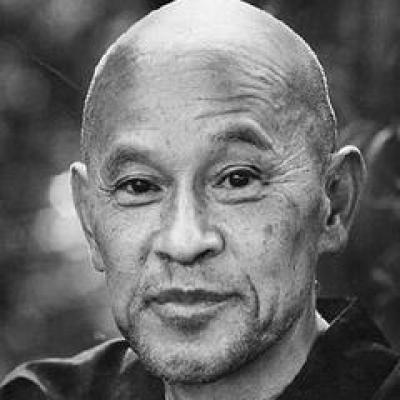
If you cannot bow to Buddha, you cannot be a Buddha. It is arrogance.
If you try to observe the precepts, that is not true observation of precepts. When you observe the precepts without trying to observe the precepts, that is true observation of the precepts.
If it is raining out, do not walk fast, because it is raining everywhere.
If your mind is empty, it is always ready for anything; it is open to everything.
Big mind is something to express, not something to figure out. Big mind is something you have, not something to seek for.
I discovered that it is necessary, absolutely necessary, to believe in nothing. That is, we have to believe in something which has no form and no color--something which exists before all forms and colors appear... No matter what god or doctrine you believe in, if you become attached to it, your belief will be based more or less on a self-centered idea.
When you are just you, without thinking or trying to say something special, just saying what is on your mind and how you feel, then there is naturally self-respect.
When we become truly ourselves, we just become a swinging door, and we are purely independent of, and at the same time, dependent upon everything.
As long as we have some definite idea about or some hope in the future, we cannot really be serious with the moment that exists right now.
When you understand one thing through and through, you understand everything.
Real Freedom is to not feel limited when wearing this Zen robe, this troublesome formal robe. Similarly, in our busy life we should wear this civilization without being bothered by it, without ignoring it, without being caught by it.
How much 'ego' do you need? Just enough so that you don't step in front of a bus.
It is easy to have calmness in inactivity, it is hard to have calmness in activity, but calmness in activity is true calmness.
The purpose of studying Buddhism is not to study Buddhism, but to study ourselves.
Because we cannot accept the truth of transience, we suffer.
Zen is everywhere.... But for you, Zen is right here.
To accept some idea of truth without experiencing it is like a painting of a cake on paper which you cannot eat.
Life and death are the same thing. When we realize this fact, we have no fear of death anymore, nor actual difficulty in our life.
Things are always changing, so nothing can be yours.
There are, strictly speaking, no enlightened people, there is only enlightened activity.
Everything is perfect, but there is a lot of room for improvement.
What we call "I" is just a swinging door which moves when we inhale and when we exhale.
A garden is never finished.
True communication depends upon our being straightforward with one another... But the best way to communicate may be just to sit without saying anything.
A flower falls, even though we love it; and a weed grows, even though we do not love it....In this way our life should be understood. Then there is no problem.
To express yourself as you are, without any intentional, fancy way of adjusting yourself, is the most important thing.
Take care of things, and they will take care of you.
When we inhale, the air comes into the inner world. When we exhale, the air goes out to the outer world. The inner world is limitless, and the outer world is also limitless. We say "inner world" or "outer world" but actually, There is just one whole world.
For Zen students a weed is a treasure. With this attitude, whatever you do, life becomes an art.
It is wisdom that is seeking for wisdom.
The point we emphasize is strong confidence in our original nature.
Everything you do is right, nothing you do is wrong, yet you must still make ceaseless effort.
To renounce things is not to give them up. It is to acknowledge that all things go away.
The highest truth is daiji, translated as dai jiki in Chinese scriptures. This is the subject of the question the emperor asked Bodhidharma: "What is the First Principle?" Bodhidharma said, "I don't know." "I don't know" is the First Principle.
You should rather be grateful for the weeds you have in your mind, because eventually they will enrich your practice.
When you try to understand everything, you will not understand anything. The best way is to understand yourself, and then you will understand everything.
When we have our body and mind in order, everything else will exist in the right place, in the right way. But usually, without being aware of it, we try to change something other than ourselves; we try to order things outside us. But it is impossible to organize things if you yourself are not in order. When you do things in the right way, at the right time, everything else will be organized.
The mind we have when we practice zazen is the great mind: we don't try to see anything; we stop conceptual thinking; we stop emotional activity; we just sit. Whatever happens to us, we are not bothered. We just sit. It is like something happening in the great sky. Whatever kind of bird flies through it, the sky doesn't care. That is the mind transmitted from Buddha to us.
Our mind should be free from traces of the past, just like the flowers of spring.
Ego is a social institution with no physical reality. The ego is simply your symbol of yourself.
In reflecting on our problems, we should include ourselves.
Enlightenment is not a complete remedy.
While you are continuing this practice, week after week, year after year, your experience will become deeper and deeper, and your experience will cover everything you do in your everyday life. The most important thing is to forget all gain ing ideas, all dualistic ideas. In other words, just practice zazen in a certain posture. Do not think about anything. Just remain on your cushion without expecting anything. Then eventually you will resume your own true nature. That is to say, your own true nature resumes itself.
When you accept everything, everything is beyond dimensions. The earth is not great nor a grain of sand small. In the realm of Great Activity picking up a grain of sand is the same as taking up the whole universe. To save one sentient being is to save all sentient beings. Your efforts of this moment to save one person is the same as the eternal merit of Buddha.
The mind of the beginner is empty, free of the habits of the experts, ready to accept, to doubt, and open to all possibilities.
Wherever you go you will find your teacher, as long as you have the eyes to see and the ears to hear.
Our way is to practice one step at a time, one breath at a time, with no gaining idea.
In the Lotus Sutra, Buddha says to light up one corner - not the whole world. Just make it clear where you are.
When you sit, everything sits with you.
It must be obvious...that there is a contradiction in wanting to be perfectly secure in a universe whose very nature is momentariness and fluidity.
In the beginner's mind there are many possibilities; in the expert's mind there are few.... In the beginner's mind there is no thought, 'I have attained something.' All self-centered thoughts limit our vast mind. When we have no thought of achievement, no thought of self, we are true beginners. We can really learn something.
Zazen practice is the direct expression of our true nature. Strictly speaking, for a human being, there is no other practice than this practice; there is no other way of life than this way of life.
Meditation opens the mind to the greatest mystery that takes place daily and hourly; it widens the heart so that it may feel the eternity of time and infinity of space in every throb; it gives us a life within the world as if we were moving about in paradise.
A student, filled with emotion and crying, implored, "Why is there so much suffering?" Suzuki Roshi replied, "No reason.
If you can just appreciate each thing, one by one, then you will have pure gratitude. Even though you observe just one flower, that one flower includes everything
You are perfect as you are and there is always room for improvement.
Although we have no actual written communications from the world of emptiness, we have some hints or suggestions about what is going on in that world, and that is, you might say, enlightenment. When you see plum blossoms or hear the sound of a small stone hitting bamboo, that is a letter from the world of emptiness.
You want to eliminate your evil desires in order to reveal your Buddha nature, but where will you throw them away?
Even though you try to put people under control, it is impossible. You cannot do it. The best way to control people is to encourage them to be mischievous. Then they will be in control in a wider sense. To give your sheep or cow a large spacious meadow is the way to control him. So it is with people: first let them do what they want, and watch them. This is the best policy. To ignore them is not good. That is the worst policy. The second worst is trying to control them. The best one is to watch them, just to watch them, without trying to control them.
Each one of us must make his own true way, and when we do, that way will express the universal way.
Zen is not some kind of excitement, but concentration on our usual everyday routine.
In the beginner's mind there is no thought, "I have attained something." All self-centered thoughts limit our vast mind. When we have no thought of achievement, no thought of self, we are true beginners. Then we can really learn something. The beginner's mind is the mind of compassion. When our mind is compassionate, it is boundless. Dogen-zenji, the founder of our school, always emphasized how important it is to resume our boundless original mind. Then we are always true to ourselves, in sympathy with all beings, and can actually practice.
Leave your front door and your back door open. Allow your thoughts to come and go. Just don't serve them tea.
The person who can freely acknowledge that life is full of difficulties can be free, because they are acknowledging the nature of life - that it can't be much else.
Even though you try very hard, the progress you make is always little by little. It is not like going out in a shower in which you know when you get wet. In a fog, you do not know you are getting wet, but as you keep walking you get wet little by little. If your mind has ideas of progress, you may say, 'Oh, this pace is terrible!' But actually it is not. When you get wet in a fog it is very difficult to dry yourself.
In order not to leave any traces, when you do something, you should do it with your whole body and mind; you should be concentrated on what you do. You should do it completely, like a good bonfire. You should not be a smoky fire. You should burn yourself completely. If you do not burn yourself completely, a trace of yourself will be left in what you do. You should not have any remains after you do something. But this does not mean to forget all about it.
So the most difficult thing is always to keep your beginner's mind. There is no need to have a deep understanding of Zen. Even though you read much Zen literature, you must read each sentence with a fresh mind. You should not say, "I know what Zen is," or "I have attained enlightenment." This is also the real secret of the arts: always be a beginner. Be very very careful about this point. If you start to practice zazen, you will begin to appreciate your beginner's mind. It is the secret of Zen practice.
Our tendency is to be interested in something that is growing in the garden, not in the bare soil itself. But if you want to have a good harvest, the most important thing is to make the soil rich and cultivate it well.
After you have practiced for a while, you will realize that it is not possible to make rapid, extraordinary progress. Even though you try very hard, the progress you make is always little by little.
There is no connection between I myself yesterday and I myself in this moment
Strictly speaking, there is no such thing as an enlightened person. There is only enlightened activity.
I think you're all enlightened, until you open your mouths.
The purpose of our practice is just to be yourself.
You must be true to your own way until at last you actually come to the point where you see it is necessary to forget all about yourself.
When you do not realize that you are one with the river, or one with the universe, you have fear. Whether it is separated into drops or not, water is water. Our life and death are the same thing. When we realize this fact, we have no fear of death anymore.
If you think your body and mind are two, that is wrong; if you think that they are one, that is also wrong. Our body and mind are both two and one.
When you are practicing zazen, do not try to stop your thinking. Let it stop by itself. If something comes into your mind, let it come in, and let it go out. It will not stay long. When you try to stop your thinking, it means you are bothered by it. Do not be bothered by anything. It appears as if something comes from outside your mind, but actually it is only the waves of your mind, and if you are not bothered by the waves, gradually they will become calmer and calmer.
Someone was sitting in front of a sunflower, watching the sunflower, a cup of sun, and so I tried it too. It was wonderful; I felt the whole universe in the sunflower. That was my experience. Sunflower meditation. A wonderful confidence appeared. You can see the whole universe in a flower.
We try, and we try, and we fail; and then we go deeper.
Don't move. Just die over and over. Don't anticipate. Nothing can save you now because you have only this moment. Not even enlightenment will help you now because there are no other moments. With no future, be true to yourself and express yourself fully. Don't move.
The most important point is to accept yourself and stand on your two feet.
Treat every moment as your last. It is not preparation for something else.
The beginner's mind is the mind of compassion. When our mind is compassionate, it is boundless.
Hell is not punishment, it's training.
It is only by practicing through a continual succession of agreeable and disagreeable situations that we acquire true strengths. To accept that pain is inherent and to live our lives from this understanding is to create the causes and conditions for happiness.
Instead of criticizing, find out how to help.
In Japan we have the phrase, "Shoshin," which means "beginner's mind." Our "original mind" includes everything within itself. It is always rich and sufficient within itself. This does not mean a closed mind, but actually an empty mind and a ready mind. If your mind is empty, it is always ready for anything. It is open to everything. In the beginner's mind there are many possibilities; in the expert's mind there are few.
Life is like stepping onto a boat which is about to sail out to sea and sink.
Moment after moment, completely devote yourself to listening to your inner voice.
Without accepting the fact that everything changes, we cannot find perfect composure. But unfortunately, although it is true, it is difficult for us to accept it. Because we cannot accept the truth of transience, we suffer.
We should not be just a fan of dragons; we should always be the dragon himself. Then we will not be afraid of any dragon.
The true practice to meditation is to sit as if you where drinking water when you are thirsty.
When you do something, you should burn yourself up completely, like a good bonfire, leaving no trace of yourself.
When you are fooled by something else, the damage will not be so big. But when you are fooled by yourself, it is fatal. No more medicine.
Discipline is creating the situation.
As long as you seek for something, you will get the shadow of reality and not reality itself.
When you live completely in each moment, without expecting anything, you have no idea of time.
When we do not expect anything we can be ourselves. That is our way, to live fully in each moment of time.
Moment after moment everything comes out of nothingness. This is the true joy of life.
In the beginner's mind there are many possibilities, in the expert's mind there are few.
To cook is not just to prepare food for someone or to cook for yourself; it is to express your sincerity. So when you cook you should express yourself in your activity in the kitchen. You should allow yourself plenty of time.
You will always exist in the universe in one form or another.
Life without zazen is like winding your clock without setting it. It runs perfectly well, but it dosen't tell time.
Nothing outside yourself can cause any trouble. You yourself make the waves in your mind. If you leave your mind as it is, it will become calm. This mind is called big mind.
In the zazen posture, your mind and body have, great power to accept things as they are, whether agreeable or disagreeable.
So when you try hard to make your own way, you will help others...before you make your own way you cannot help anyone, and no one can help you.
As soon as you see something, you already start to intellectualize it. As soon as you intellectualize something, it is no longer what you saw.
And we should forget, day by day, what we have done; this is true non-attachment. And we should do something new. To do something new, of course we must know our past, and this is alright. But we should not keep holding onto anything we have done; we should only reflect on it. And we must have some idea of what we should do in the future. But the future is the future, the past is the past; now we should work on something new.
Nothing we see or hear is perfect. But right there in the imperfection is perfect reality.
Concentration comes not from trying hard to focus on something, but from keeping your mind open and directing it at nothing.
Time goes from present to past.
No teaching could be more direct than just to sit down.
Happiness is sorrow; sorrow is happiness. There is happiness in difficulty; difficulty in happiness. Even though the ways we feel are different, they are not really different, in essence they are the same. This is the true understanding transmitted from Buddha to us.
When my master and I were walking in the rain, he would say, 'Do not walk so fast, the rain is everywhere.'
The true purpose of Zen is to see things as they are, to observe things as they are, and to let everything go as it goes. Zen practice is to open up our small mind.
To find perfect composure in the midst of change is to find nirvana.
Our practice should be based on the ideal of selflessness. Selflessness is very difficult to understand. If you try to be selfless, that is already a selfish idea. Selflessness will be there when you do not try anything.
Faith is a state of openness or trust...In other words, a person who is fanatic in matters of religion, and clings to certain ideas about the nature of God and the universe, becomes a person who has no faith at all. Instead they are holding tight. But the attitude of faith is to let go, and become open to the truth, whatever it might turn out to be.
To stop your mind does not mean to stop the activities of mind. It means your mind pervades your whole body.
So the secret is just to say 'Yes!' and jump off from here. Then there is no problem. It means to be yourself, always yourself, without sticking to an old self.
The secret of Soto Zen is just two words: not always so.... In Japanese, it's two words, three words in English. That is the secret of our practice.
The practice of Zen mind is beginner's mind. The innocence of the first inquiry—what am I?—is needed throughout Zen practice. The mind of the beginner is empty, free of the habits of the expert, ready to accept, to doubt, and open to all the possibilities. It is the kind of mind which can see things as they are, which step by step and in a flash can realize the original nature of everything.
So for a period of time each day, try to sit, without moving, without expecting anything, as if you were in your last moment. Moment after moment you feel your last instant. In each inhalation and each exhalation there are countless instants of time. Your intention is to live in each instant.
The seed has no idea of being some particular plant, but it has its own form and is in perfect harmony with the ground, with its surroundings ... and there is no trouble. This is what we mean by naturalness.
Whereever you are, you are one with the clouds and one with the sun and the stars you see. You are one with everything. That is more true than I can say, and more true than you can hear.