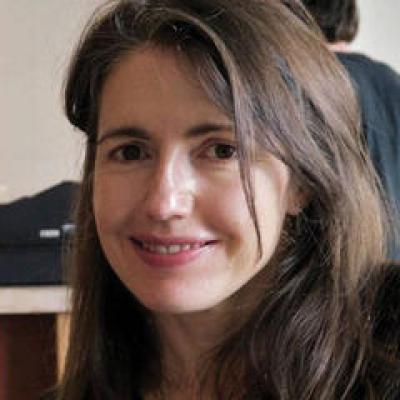
I think people perceive my creatures as absurd because they look different, but at the same time, they are a little bit familiar. I want people to feel a kind of empathy with them. When you think about it, all nature is kind of strange looking.. in fact, I'm a strange a looking creature.
I don't think 'Dark Heart' has to be malevolent. It conveys a sense of depth. There is a sense of questioning turmoil.
Now that other people have my works, it's really important to me that what they have has longevity.
In the studio we use a pretty wide range of materials for the sculptures; silicone, fibreglass, human and animal hair, ABS plastic, dental acrylic, traditional and high-tech plasters, stainless steel, automotive paint, plywood, Britannia metal, found objects and taxidermy animals.
How does contemporary technology and culture changes our understanding of what it means to be human. What is our relationship with - and responsibilities towards - that which we create.
I would say my work is anti-ironic.
Skywhale is ambiguous. I think she is beautiful, but a lot of people think she is grotesque. You are drawn in and repelled at the same time, and it has to have that dynamic. My work has a certain element of abject mutation, uncertainty and darkness. Even she is dark - I mean she has ten breasts.
Obviously, I don't make an entire edition all at once, so the studio often goes back to produce editions, but that's a bit different. I guess I'm always thinking about the next work.
Thinking is a social process. I talk to everyone from children to anthropologists and philosophers. I try my ideas out on people and they talk back to you. That's how ideas get formed.
My practice is focused on bodies and relationships; the relationships between people and other creatures, between people and our bodies, between creatures and the environment, between the artificial and the natural.
I finished VCA at the height of the last big recession in the early 90s, and seeing that I was not going to be able to join one of the dwindling number of commercial galleries, I started an ARI called the Basement Project which ran for three years. Things came a little at a time and all of a sudden it's 20 years later and I'm still making art, which is really all I ever wanted to do.
For one work we developed a human hair felt, which involved collecting and sorting hundreds of kilos of human hair, and then blending it will a tiny percentage of black merino followed by carding and felting.
I use whatever media I think will best express my ideas and therefore I don't have a lot invested in the idea of photography specifically. I am more interested in Art.
The illusion of life is crucial for the work, otherwise the ideas wouldn't be able to jump across, people wouldn't engage with it.
I started thinking of digital imaging, not photography, in 1994 as it seemed the most appropriate way to deal with ideas of biotechnology and advertising. My practice is conceptual.
I am particularly interested in the way that the everyday realities of the world around us change these relations.
Most of the work I make uses materials that are a bit outside of the traditional fine art world.
Ideas rather than methods are central to they way I work, although drawing plays a central generative role in everything I do.
I don't want the ideas to be limited by what I can physically do. The ideas come first.
Quality and longevity are the primary criteria, along with repairability and ease of production.
We always use plywood rather than MDF for structural stuff for the same reasons [stability].
I put a lot of time and thought into my work, which I see as a sort of respect for both the work and the audience, and I have always been very concerned that the materiality of the work reflects that.
I have had sculptures cast in bronze, silver and aluminium. My drawings are all graphite or pigment ink and gouache on paper.
A child came up to me and asked 'am I dreaming?' I had a similar experience coming to the Art Gallery of South Australia when I was a child. My mum had done a workshop here and it stayed with me. It's an important formative time.
Melbourne is a fantastic place to work, but it's not the centre of the world.
It's much easier to do something that's seen as being serious because people accept it right away, they don't question what you do, they just accept, because they think you must be right.
Artists make worlds for people to walk through.
The silicone we use is the hardest, most UV stable we can get, and we have done enormous amounts of testing and research to get a paint solution that is extremely hardy and repairable.
I usually have several things on the go. Whether it is my own drawings for the next work that I am working on while a sculpture is being fabricated or several works at different points in production.
I pretty much keep everything; we have drawers full of samples and tests and every old catalogue and magazine.
The idea that we can have a new life form, what does it say about the zoo's main purpose, which is to preserve life? What does it say when the artificial and real animal can have the same attraction to people?
We tend to be talking to fabricators in the film and special effects or automotive customisation worlds. That having been said, I'm sure as more and more artists come to use these sorts of media, the expertise amongst conservators is going to keep pace with that.
If there are moments in my work when people find joy and humour, that's a real success for me.
For me it is a matter of respect for the ideas in the work and the people who look at them. I absolutely hate it when works come back to the studio for repair, and I try to make sure that they never do.
I certainly don't see the humour in my work as something that detracts from its seriousness. It's just a way of making difficult messages more palatable.
Materials are very important to me, and always have been.
The studio keeps notes on the details of editions and production processes and the like.
The studio does a lot of testing before we settle on a system. Unfortunately, this means that price tends to come pretty far down the list.
It's interesting to work with what's important today, which is meaningful for our everyday lives.
We always use resin instead of polyurethane, even though it takes more work and is in places where it can't be seen, because resin tends to be more UV stable than urethane.
We did have one work where it looked like the fibreglass was discolouring, but it turned out it was reacting to the foam it was packed against in storage. We repaired it and sent it back with better packing.
I struggle in life to find a sense of joy in things.
Perhaps because of this, many have looked at my practice in terms of science and technology, however, for me it is just as informed by Surrealism and mythology.
I have been interested in visual arts since high school and, after realising that I had absolutely no interest in the economics degree I had undertaken at ANU, I started a BFA in Sydney which I completed at VCA in Melbourne.
As we get older, our world gets smaller and we start to doubt and question. We are really suspicious of difference.
I feel that there's hardly any irony in my work; if there's anything, there'll be sincerity, which people sometimes find hard to deal with.
I don't connect accessibility with lowest common denominator.
Of course, all my work is photographed and I also take quite a lot of photographs of work in production.
My Father is a photographer, so it was always around. I was trained in painting, so I learnt a lot of skills about composition, light, colour, the formal attributes of images.
I have a database of all my works that I maintain to keep track of works and editions.
In the studio we spend a lot of time working our what materials will work best and also last. We do tests and come back to them years later to see how they are still performing, and this leads our decisions.
I tend to work towards specific exhibitions, so there will often be a big push towards the end when we're finishing off a bunch of stuff.
The way we look at nineteenth-century English social realism and appreciate the working classes of the emerging industrial revolution.
In one hundred years time people will look back and think 'these people were really worried about the environment, they were looking at things to do with global warming, and this is why they were making work about these issues'.
I don't set out to make something that is repulsive and that would scare people. I know that some people don't like what I make, and don't find it cute, but that's hard for me to understand.
I work with whatever mediums seems best suited to evoking the sorts of thoughts and emotions I am interested in playing with.