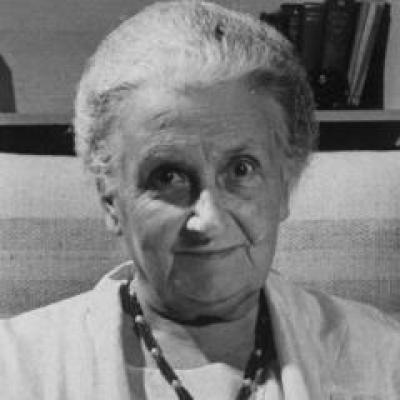
We must help the child to act for himself, will for himself, think for himself; this is the art of those who aspire to serve the spirit.
The essence of independence is to be able to do something for one’s self.
To assist a child we must provide him with an environment which will enable him to develop freely.
Only through freedom and environmental experience is it practically possible for human development to occur.
All our handling of the child will bear fruit, not only at the moment, but in the adult they are destined to become.
The child, in fact, once he feels sure of himself, will no longer seek the approval of authority after every step.
The child has a mind able to absorb knowledge. He has the power to teach himself.
Two things are necessary, the development of individuality and the participation of the individual in a truly social life.
The senses, being the explorers of the world, open the way to knowledge.
The development of the child during the first three years after birth is unequaled in intensity and importance by any period that precedes or follows in the whole life of the child.
The work of education is divided between the teacher and the environment.
The education of even a small child, therefore, does not aim at preparing him for school, but for life.
The exercises of practical life are formative activities, a work of adaptation to the environment. Such adaptation to the environment and efficient functioning therein is the very essence of a useful education.
The role of education is to interest the child profoundly in an external activity to which he will give all his potential
The child is endowed with unknown powers, which can guide us to a radiant future. If what we really want is a new world, then education must take as its aim the development of these hidden possibilities.
Free the child's potential, and you will transform him into the world.
The adult works to improve his environment while the child works to improve himself.
Watching a child makes it obvious that the development of his mind comes through his movements.
This is the treasure we need today - helping the child become independent of us and make his way by himself, receiving in return his gifts of hope and light.
Never help a child with a task that they feel they can complete themselves.
When children come into contact with nature, they reveal their strength.
Imitation is the first instinct of the awakening mind.
Character formation cannot be taught. It comes from experience and not from explanation.
The goal of early childhood education should be to activate the child's own natural desire to learn.
Joy, feeling one’s own value, being appreciated and loved by others, feeling useful and capable of production are all factors of enormous value for the human soul.
These words reveal the child’s inner needs; ‘Help me to do it alone’.
Education should no longer be most imparting of knowledge, but must take a new path, seeking the release of human potentialities.
A child is a discoverer. He is an amorphous, splendid being in search of his own proper form.
Respect all the reasonable forms of activity in which the child engages and try to understand them.
The most important period of life is not the age of university studies, but the first one, the period from birth to the age of six.
The hands are the instruments of man’s intelligence.
To teach details is to bring confusion; to establish the relationship between things is to bring knowledge.
The child can only develop fully by means of experience in his environment. We call such experience 'work'.
Free choice is one of the highest of all the mental processes.
The land is where our roots are. The children must be taught to feel and live in harmony with the Earth.
The child is both a hope and a promise for mankind.
There is no description, no image in any book that is capable of replacing the sight of real trees, and all of the life to be found around them in a real forest.
Praise, help, or even a look, may be enough to interrupt him, or destroy the activity. It seems a strange thing to say, but this can happen even if the child merely becomes aware of being watched. After all, we too sometimes feel unable to go on working if someone comes to see what we are doing. The great principle which brings success to the teacher is this: as soon as concentration has begun, act as if the child does not exist. Naturally, one can see what he is doing with a quick glance, but without his being aware of it.
The real preparation for education is the study of one's self.
It is not enough for the teacher to love the child. She must first love and understand the universe. She must prepare herself, and truly work at it.
One test of the correctness of educational procedure is the happiness of the child.
The needs of mankind are universal. Our means of meeting them create the richness and diversity of the planet. The Montessori child should come to relish the texture of that diversity.
There must be provision for the child to have contact with nature; to understand and appreciate the order, the harmony and the beauty in nature.
Of all things love is the most potent.
It is true that we cannot make a genius. We can only give to teach child the chance to fulfil his potential possibilities.
The development of the mind comes through movement
When the child goes out, it is the world itself that offers itself to him. Let us take the child out to show him real things instead of making objects which represent ideas and closing them up in cupboards.
Whatever is presented to him must be made beautiful and clear, striking his imagination. Once this love has been kindled, all problems confronting the educationist will disappear.
A child needs freedom within limits.
Teach by teaching, not by correcting
Children have an anxious concern for living beings, and the satisfaction of this instinct fills them with delight. It is therefore easy to interest them in taking care of plants and especially of animals. Nothing awakens foresight in a small child such as this. When he knows that animals have need of him, that little plants will dry up if he does not water them, he binds together with a new thread of love today's passing moments with those of the morrow.
The first duty of the educator, whether he is involved with the newborn infant or the older child, is to recognize the human personality of the young being and respect it.
The first aim of the prepared environment is, as far as it is possible, to render the growing child independent of the adult.
To let the child do as he likes when he has not yet developed any powers of control is to betray the idea of freedom.
The real preparation for education is a study of one's self. The training of the teacher...is something far more than a learning of ideas. It includes the training of character; it is a preparation of the spirit.
Peace is what every human being is craving for, and it can be brought about by humanity through the child.
Growth is not merely a harmonious increase in size, but a transformation.
The more the capacity to concentrate is developed, the more often the profound tranquility in work is achieved, then the clearer will be the manifestation of discipline within the child.
Any child who is self-sufficient, who can tie his shoes, dress or undress himself, reflects in his joy and sense of achievement the image of human dignity which is derived from a sense of independence.
What the hand does the mind remembers.
The child builds his inmost self out of the deeply held impressions he receives.
We must support as much as possible the child's desires for activity; not wait on him, but educate him to be independent.
Joy is the evidence of inner growth.
If education recognizes the intrinsic value of the child's personality and provides an environment suited to spiritual growth, we have the revelation of an entirely new child whose astonishing characteristics can eventually contribute to the betterment of the world.
Children display a universal love of mathematics, which is par excellence the science of precision, order, and intelligence.
The environment itself will teach the child, if every error he makes is manifest to him, without the intervention of a parent of teacher, who should remain a quiet observer of all that happens.
Never help a child with a task at which he feels he can succeed.
It is exactly in the repetition of the exercises that the education of the senses exists; not that the child shall know colors, forms or qualities, but that he refine his senses through an exercise of attention, comparison and judgment.
The child who has felt a strong love for his surroundings and for all living creatures, who has discovered joy and enthusiasm in work, gives us reason to hope that humanity can develop in a new direction.
Imagination does not become great until human beings, given the courage and the strength, use it to create.
The greatest sign of success for a teacher...is to be able to say, "The children are now working as if I did not exist."
What we need is a world full of miracles, like the miracle of seeing the young child seeking work and independence, and manifesting a wealth of enthusiasm and love.
The child will reveal himself through work.
A child is an eager observer and is particularly attracted by the actions of the adults and wants to imitate them. In this regard an adult can have a kind of mission. He can be an inspiration for the child's actions, a kind of open book wherein a child can learn how to direct his own movements. But an adult, if he is to afford proper guidance, must always be calm and act slowly so that the child who is watching him can clearly see his actions in all their particulars.
The child who concentrates is immensely happy
The child, making use of all that he finds around him, shapes himself for the future.
The child is truly a miraculous being, and this should be felt deeply by the educator.
...we discovered that education is not something which the teacher does, but that it is a natural process which develops spontaneously in the human being. It is not acquired by listening to words, but in virtue of experiences in which the child acts on his environment. The teacher's task is not to talk, but to prepare and arrange a series of motives for cultural activity in a special environment made for the child.
The child has other powers than ours, and the creation he achieves is no small one; it is everything.
Children are human beings to whom respect is due, superior to us by reason of their innocence and of the greater possibilities of their future.
An education capable of saving humanity is no small undertaking; it involves the spiritual development of man, the enhancement of his value as an individual, and the preparation of young people to understand the times in which they live.
We are the sowers - our children are those who reap. We labor so that future generations will be better and nobler than we are.
An interesting piece of work, freely chosen, which has the virtue of inducing concentration rather than fatigue, adds to the child's energies and mental capacities, and leads him to self-mastery.
To consider the school as a place where instruction is given is one point of view. But, to consider the school as a preparation for life is another. In the latter case, the school must satisfy all the needs of life.
The greatest triumph of our educational method should always be this: to bring about the spontaneous progress of the child.
First the education of the senses, then the education of the intellect.
The first essential for the child’s development is concentration. The child who concentrates is immensely happy.
Do not tell them how to do it. Show them how to do it and do not say a word. If you tell them, they will watch your lips move. If you show them, they will want to do it themselves.
He does it with his hands, by experience, first in play and then through work. The hands are the instruments of man's intelligence.
The whole of mankind is one and only one, one race, one class and one society.
Our aim is not merely to make the child understand, and still less to force him to memorize, but so to touch his imagination as to enthuse him to his innermost core.
A child's work is to create the person she/he will become.
It is the child who makes the man, and no man exists who was not made by the child he once was.
At a given moment a child becomes interested in a piece of work, showing it by the expression of his face, by his intense attention, by his perseverance in the same exercise. That child has set foot upon the road leading to discipline.
We shall walk together on this path of life, for all things are part of the universe and are connected with each other to form one whole unity.
Our care of the child should be governed, not by the desire to make him learn things, but by the endeavor always to keep burning within him that light which is called intelligence.
Concentration is the key that opens up to the child the latent treasures within him.
If we really want children to grow into independent and resourceful adults, we should stop pouring their milk as soon as they have learned to pour it themselves and stop fastening their buttons as soon as they can fasten them without help.
As soon as children find something that interests them they lose their instability and learn to concentrate.
The teacher's task is not a small easy one! She has to prepare a huge amount of knowledge to satisfy the child's mental hunger. She is not like the ordinary teacher, limited by a syllabus. The needs of the child are clearly more difficult to answer.
Giving children the opportunity to stir up life and leave it free to discover.
Children become like the things they love.
Every great cause is born from repeated failures and from imperfect achievements.
There is a great sense of community within the Montessori classroom, where children of differing ages work together in an atmosphere of cooperation rather than competitiveness. There is respect for the environment and for the individuals within it, which comes through experience of freedom within the community.
We shall walk together on this path of life, for all things are a part of the universe, and are connected with each other to form one whole unity. This idea helps the mind of the child to become fixed, to stop wandering in an aimless quest for knowledge. He is satisfied, having found the universal centre of himself with all things.
It is well to cultivate a friendly feeling towards error, to treat it as a companion inseparable from our lives, as something having a purpose, which it truly has.
The secret of good teaching is to regard the child's intelligence as a fertile field in which seeds may be sown, to grow under the heat of flaming imagination.
The unknown energy that can help humanity is that which lies hidden in the child.
Play is the work of the child.
The essence of independence is to be able to do something for one’s self. Adults work to finish a task, but the child works in order to grow, and is working to create the adult, the person that is to be. Such experience is not just play... it is work he must do in order to grow up.
Let the children be free; encourage them; let them run outside when it is raining; let them remove their shoes when they find a puddle of water; and when the grass of the meadows is wet with dew, let them run on it and trample it with their bare feet; let them rest peacefully when a tree invites them to sleep beneath its shade; let them shout and laugh when the sun wakes them in the morning.
The environment must be rich in motives which lend interest to activity and invite the child to conduct his own experiences.
A child is mysterious and powerful; And contains within himself the secret of human nature.
There is in the child a special kind of sensitivity which leads him to absorb everything about him, and it is this work of observing and absorbing that alone enables him to adapt himself to life
The child should live in an environment of beauty.
Whoever touches the life of the child touches the most sensitive point of a whole which has roots in the most distant past and climbs toward the infinite future.
Within the child lies the fate of the future.
Order is one of the needs of life which, when it is satisfied, produces a real happiness
Discipline must come through liberty. . . . We do not consider an individual disciplined only when he has been rendered as artificially silent as a mute and as immovable as a paralytic. He is an individual annihilated, not disciplined.
Education cannot be effective unless it helps a child to open up himself to life.
It is necessary for the teacher to guide the child without letting him feel her presence too much, so that she may always be ready to supply the desired help, but may never be the obstacle between the child and his experience.
Growth comes from activity, not from intellectual understanding.
Sometimes very small children in a proper environment develop a skill and exactness in their work that can only surprise us.
There can be no substitute for work, neither affection nor physical well-being can replace it.
The child has a different relation to his environment from ours... the child absorbs it. The things he sees are not just remembered; they form part of his soul. He incarnates in himself all in the world about him that his eyes see and his ears hear.