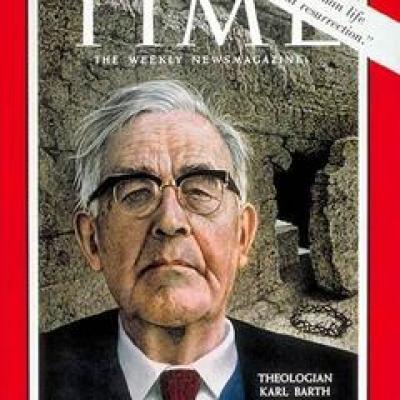
Radically and basically, all sin is simply ingratitude.
Sin is not confined to the evil things we do. It is the evil within us, the evil which we are.
Mozart creates music from a mysterious center, and so knows the limits to the right and the left, above and below. He maintains moderation.
Grace and gratitude belong together like heaven and earth. Gratitude evokes grace like the voice and echo. Gratitude follows grace as thunder follows lightning.
The Spirit bears witness. Ecstasy and enlightenment, inspiration and intuition are not necessary. Happy is the man who is worthy of these; but woe unto us if we wait for such experiences; woe unto us if we do not perceive that these things are of secondary importance.
The enterprise of Adolf Hitler, with all its clatter and fireworks, and all its cunning and dynamic energy, is the enterprise of an evil spirit, which is apparently allowed its freedom for a time in order to test our faith in the Resurrection of Jesus Christ.
Exegesis, exegesis, and yet more exegesis!
On the basis of the eternal will of God we have to think of EVERY HUMAN BEING, even the oddest, most villainous or miserable, as one to whom Jesus Christ is Brother and God is Father; and we have to deal with him on this assumption. If the other person knows that already, then we have to strengthen him in the knowledge. If he does no know it yet or no longer knows it, our business is to transmit this knowledge to him.
Thus in this oneness Jesus Christ is the Mediator, the Reconciler, between God and man. Thus He comes forward to MAN on behalf of GOD calling for and awakening faith, love and hope, and to GOD on behalf of MAN, representing man, making satisfaction and interceding. Thus He attests and guarantees to God's free GRACE and at the same time attests and guarantees to God man's free GRATITUDE.
When we are at our wits' end for an answer, then the Holy Spirit can give us an answer. But how can He give us an answer when we are still well supplied with all sorts of answers of our own?
We are now assuming that we have here the centre and goal of all God's works, and therefore the hidden beginning of them all. We are also assuming that the prominent place occupied by this divine work has something corresponding to it in the essence of God, that the Son forms the centre of the Trinity, and that the essence of the divine being has, so to speak, its locus ... in His work, in the name and person of Jesus Christ.
I take the Bible far too seriously to take it literally.
To say revelation is to say, 'the Word became flesh...'
Our position is such that we can be rescued from eternal death and translated into life only by total and unceasing substitution, the substitution which God Himself undertakes on our behalf.
The Christian Church does not exist in Heaven, but on earth and in time.
I haven't even read everything I wrote.
The angels laugh at old Karl. They laugh at him because he tries to grasp the truth about God in a book of Dogmatics. They laugh at the fact that volume follows volume, and each is thicker than the previous ones. As they laugh, they say to one another, ‘Look! Here he comes now with his little pushcart full of volumes of the Dogmatics!’—and they laugh about the persons who write so much about Karl Barth instead of writing about the things he is trying to write about. Truly, the angels laugh.
The theologian who labours without joy is not a theologian at all.
All sin has its being and origin in the fact that man wants to be his own judge. And in wanting to be that, and thinking and acting accordingly, he and his whole world is in conflict with God. It is an unreconciled world, and therefore a suffering world, a world given up to destruction.
The gospel is not a truth among other truths. Rather, it sets a question mark against all truths.
No one can be saved - in virtue of what he can do. Everyone can be saved - in virtue of what God can do.
To be a Christian and to pray are one and the same thing; it is a matter that cannot be left to our caprice. It is a need, a kind of breathing necessary to life.
A free theologian works in communication with other theologians...He waits for them and asks them to wait for him. Our sadly lacking yet indispensable theological co-operation depends directly or indirectly on whether or not we are wiling to wait for one another, perhaps lamenting, yet smiling with tears in our eyes.
Faith is never identical with piety even if it were the purest and finest.
What is offered to man's apprehension in any specific revelation of Christ is the living God himself.
To clasp the hands in prayer is the beginning of an uprising against the disorder of the world.
When the frontier between God and man, the last inexorable barrier and obstacle, is not closed, the barrier between what is normal and what is perverse is opened.
Whether the angels play only Bach praising God, I am not quite sure.
Grace and gratitude go together like heaven and earth.
Man can certainly keep on lying (and does so), but he cannot make truth falsehood.
The Truth lies not in the Yes and not in the No, but in the knowledge and the beginning from which the Yes and the No arise.
Jesus Christ, as he is attested to us in Holy Scripture, is the one Word of God whom we have to hear, and whom we have to trust and obey in life and in death.
The relation of this God with this man; the relation of this man with this God--this is the only theme of the Bible and of philosophy.
What happened on that day (of Easter) became, was and remained the centre around which everything else moves. For everything lasts its time, but the love of God - which was at work and was expressed in the resurrection of Jesus Christ from the dead - lasts forever. Because this event took place, there is no reason to despair, and even when we read the newspaper with all its confusing and frightening news, there is every reason to hope.
Jesus does not give recipes that show the way to God as other teachers of religion do. He is himself the way.
When I come before these men I do not have to explain that we are all sinners. They have committed every sin there is. All I have to tell them is that I, too, am a sinner.
Prayer without study would be empty. Study without prayer would be blind.
When we speak of our virtues we are competitors, when we confess our sins we become brothers.
A being is free only when it can determine and limit its activity.
Jesus loves me, this I know, for the Bible tells me so?
Mozart's music is free of all exaggeration, of all sharp breaks and contradictions. The sun shines but does not blind, does not burn or consume. Heaven arches over the earth, but it does not weigh it down, it does not crush or devour it.
There will be no song on our lips if there be no anguish in our hearts.
The statement that 'God is dead' comes from Nietzsche and has recently been trumpeted abroad by some German and American theologians. But the good Lord has not died of this; He who dwells in the heaven laughs at them.
The resurrection of Jesus was like a boulder crashing into the pool of history.
Mozart's music always sounds unburdened, effortless, and light. This is why it unburdens, releases, and liberates us.
For the millions that suffer unjustly, the Confessing Church does not yet have a heart.
This much is certain, that we have no theological right to set any sort of limits to the loving-kindness of God which has appeared in Jesus Christ. Our theological duty is to see and understand it as being still greater than we had seen before.
It may be that when the angels go about their task praising God, they play only Bach. I am sure, however, that when they are together en famille they play Mozart.
The nativity mystery “conceived from the Holy Spirit and born from the Virgin Mary”, means, that God became human, truly human out of his own grace. The miracle of the existence of Jesus , his “climbing down of God” is: Holy Spirit and Virgin Mary! Here is a human being, the Virgin Mary, and as he comes from God, Jesus comes also from this human being. Born of the Virgin Mary means a human origin for God. Jesus Christ is not only truly God, he is human like every one of us. He is human without limitation. He is not only similar to us, he is like us.
He [Jesus Christ] is the Master of all as the Servant of all.
We act unbelievingly and disobediently when, for whatever motive, we distort, falsify, or suppress the facts about our life in nature and history.
God listens to Bach while the angels listen to Mozart.
Grace must find expression in life, otherwise it is not grace.
The best theology would need no advocates; it would prove itself.
Sin scorches us most after it comes under the scrutinizing light of God's forgiveness and not before
Christian worship is the most momentous, most urgent, most glorious action that can take place in human life.
With an ear open to your musical dialectic, one can be young and become old, can work and rest, be content and sad: in short, one can live.
I don’t believe in universalism, but I do believe in Jesus Christ, the reconciler of all
Abortion is 'the great modern sin.
I had to show that the Bible dealt with an encounter between God and Man. I thought only of the apartness of God. What I had to learn after that was the togetherness of Man and God - a union of two totally different kinds of beings.
Humor is the opposite of all self-admiration and self-praise.
Mozart's music is an invitation to the listener to venture just a little out of the sense of his own subjectivity.
In the Church of Jesus Christ there can and should be no non-theologians.
No act of man can claim to be more than an attempt, not even science.
Theology is not a private subject for theologians only. Nor is it a private subject for professors. Fortunately, there have always been pastors who have understood more about theology than most professors. Nor is theology a private subject of study for pastors. Fortunately, there have repeatedly been congregation members, and often whole congregations, who have pursued theology energetically while their pastors were theological infants or barbarians. Theology is a matter for the Church.
It is always the case that when the Christian looks back, he is looking at the forgiveness of sins.
One drop of eternity is of greater weight than a vast ocean of finite things.
Joy is the simplest form of gratitude.
I have read many books, but the Bible reads me.
Man can certainly keep on lying... but he cannot make truth falsehood. He can certainly rebel... but he can accomplish nothing which abolishes the choice of God.
The Devil may also make use of morality.
The person who knows only his side of the argument knows little of that.
Faith is not an art. Faith is not an achievement. Faith is not a good work of which some may boast while others can excuse themselves with a shrug of the shoulders for not being capable of it. It is a decisive insight of faith itself that all of us are incapable of faith in ourselves, whether we think of its preparation, beginning, continuation, or completion.
We must read the Bible through the eyes of shipwrecked people for whom everything has gone overboard.
Impossibility is more possible than everything which we hold to be possible.
Take your Bible and take your newspaper, and read both. But interpret newspapers from your Bible.
Grace creates liberated laughter. The grace of God...is beautiful, and it radiates joy and awakens humor.
That the zeal for God's honor is also a dangerous passion, that the Christian must bring with him the courage to swim against the tide instead of with it... accept a good deal of loneliness, will perhaps be nowhere so clear and palpable as in the church, where he would so much like things to be different. Yet he cannot and he will not refuse to take this risk and pay this price... he belongs where the reformation of the church is underway or will again be underway.
The theologian who labors without joy is not a theologian at all. Sulky faces, morose thoughts and boring ways of speaking are intolerable in this field.
True theology is an actual determination and claiming of man by the acting God.
Where dogmatics exists at all, it exists only with the will to be a Church dogmatics, a dogmatics of the ecumenical Church.
Scientific dogmatics must devote itself to the criticism and correction of Church proclamation and not just to a repetitive exposition of it.
Conscience is the perfect interpreter of life.
There is no philosophy that is not to some extent also theology.
Society is now really ruled by its own logos; say rather by a whole pantheon of its own hypostases and powers... we are beginning to suspect that the idols are vain, but their demonic influence upon our lives is not thereby allayed. For it is one thing to entertain critical doubts regarding the god of this world, and another thing to perceive the dunamis, the meaning and might of the living God who is building a new world.
We must hold the Bible in one hand and the newspaper in the other.
Let us hear what the Bible says and what we as Christians are called to hear together: By grace you have been saved.
If I have a system it is limited to a recognition of what Kierkegaard called 'the infinite qualitative distinction' between time and eternity
Man can certainly flee from God... but he cannot escape him. He can certainly hate God and be hateful to God, but he cannot change into its opposite the eternal love of God which triumphs even in his hate.
Faith in God's revelation has nothing to do with an ideology which glorifies the status quo.
Humanity in its basic form is co-humanity.
Laughter is the closest thing to the grace of God.
We have before us the fiendishness of business competition and the world war, passion and wrongdoing, antagonism between classes and moral depravity within them, economic tyranny above and the slave spirit below.
Exactly halfway between exegesis and practical theology stands dogmatics.
The term 'laity' is one of the worst in the vocabulary of religion and ought to be banished from the Christian conversation.
Religion is the possibility of the removal of every ground of confidence except confidence in God alone.
In dogmatics our question is: What are we to think and say?
Men have never been good, they are not good and they never will be good.
Belief cannot argue with unbelief, it can only preach to it.
As ministers we ought to speak of God. We are human, however, and so cannot speak of God. We ought therefore to recognize both our obligation and our inability and by that very recognition give glory to God
'joy' in Phillippians is a defiant 'Nevertheless!' that Paul sets like a full stop against the Philippians' anxiety.
Dogmatics is the testing of Church doctrine and proclamation.
What expressions we used - in part taken over and in part newly invented! above all, the famous 'wholly other' breaking in upon us 'perpendicularly from above,' the not less famous 'infinite qualitative distinction' between God and man, the vacuum, the mathematical point, and the tangent in which alone they must meet.
In Jesus, God wills to be true God not only in the height but also in the depth - in the depth of human creatureliness, sinfulness and mortality.
Jews have God's promise and if we Christians have it, too, then it is only as those chosen with them, as guests in their house, that we are new wood grafted onto their tree.
There is a notion that complete impartiality is the most fitting and indeed the normal disposition for true exegesis , because it guarantees complete absence of prejudice. For a short time, around 1910, this idea threatened to achieve almost a canonical status in Protestant theology. But now, we can quite calmly describe it as merely comical.
What God chooses for us children of men is always the best.