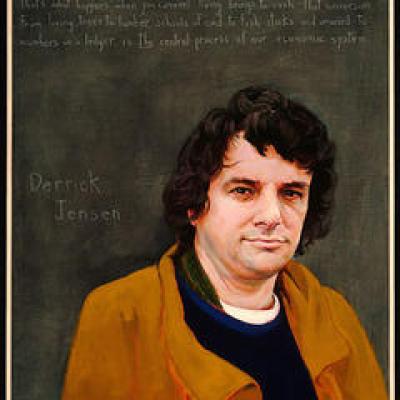
A wonderful thing happens when you give up on hope, which is that you realize you never needed it in the first place. You realize that giving up on hope doesn't kill you, nor did it make you less effective. In fact it made you more effective, because you ceased relying on someone or something else to solve your problems - you ceased hoping your problems somehow get solved, through the magical assistance of God, the Great Mother, the Sierra Club, valiant tree-sitters, brave salmon, or even the Earth itself - and you just began doing what's necessary to solve your problems yourself.
We are members of the most destructive culture ever to exist. Our assault on the natural world, on indigenous and other cultures, on women, on children, on all of us through the possibility of nuclear suicide and other means--all these are unprecedented in their magnitude and ferocity.
We have a need for enchantment that is as deep and devoted as our need for food and water.
You can rarely prove something to someone who does not want to see it proven, and even more to the point, you can almost never prove something to someone who has financial or ideological reasons to not see it proven.
Those in power have made it so we have to pay simply to exist on the planet. We have to pay for a place to sleep, and we have to pay for food. If we don't, people with guns come and force us to pay. That's violent.
The pretense that humans are superior to nonhumans is entirely unsupportable. I have seen no compelling evidence that humans are particularly more "intelligent" than any other creature. I have had long and fruitful relationshis with many nonhuman animals, both domesticated and wild, and have reveled in the bouquet of radically different intelligences - different forms, not different "quantities" that they have introduced to me, each in his or her own time, in his or her own way.
When we realize the degree of agency we actually do have, we no longer have to "hope" at all. We simply do the work.
Have you ever felt love? Did you need scientific proof of this? How would you have definitively and scientifically proved your love existed? If you could not prove it, would that mean your love didn't exist? What would you trust: your own feelings, or science?
For us to maintain our way of living, we must tell lies to each other and especially to ourselves. The lies are necessary because, without them, many deplorable acts would become impossibilities.
Violence, and evil, doesn't always come dressed in black, and it doesn't always look like Charles Manson. Nor does it always come to us as obvious and arrogant[...]. Often it comes to us with the simple plea to be reasonable.
Forests precede us and deserts dog our heels.
By deafening ourselves to the emotional consequences of violence we have become confused by its relationship to sex. We have come to believe that violence equals aggression, and we have come to base our model of sexuality on our model of violence... converting an act of aggression into an act of consensual sexuality.
I am only so beautiful as the character of my relationships, only so rich as I enrich those around me, only so alive as I enliven those I greet.
In order to maintain our way of living, we must tell lies to each other, and especially to ourselves.
A primary purpose of the police is to enforce the delusions of those with lots of green paper.
Slavery was a central concern of governance form the time of the first nation-state. The Code of Hammurabi, the earliest know set of laws for governing an empire, prescribed death for anyone who harbored a fugitive or otherwise helped a slave to escape. The relationship between the law and bondage goes back even farther: Indeed, the oldest extant legal documents don't concern the sale of land, houses, or even animals, but slaves.
I think a lot of us are increasingly recognizing that the dominant culture is killing the planet.
All the mega corporations on the planet make their obscene profits off the labor and suffering of others, with complete disregard for the effects on the workers, environment, and future generations. We have a straightforward proposal: if they want public money, we want public control. It's that simple.
Like the layers of an onion, under the first lie is another, and under that another, and they all make you cry.
We must learn how to think like the planet.
To be clear, civilization is not the same as society. Civilization is a specific, hierarchical organization based on 'power over.' Dismantling civilization, taking down that power structure, does not mean the end of all social order. It should ultimately mean more justice, more local control, more democracy, and more human rights, not less.
No matter what we call it, poison is still poison, death is still death, and industrial civilization is still causing the greatest mass extinction in the history of the planet.
There is always money to kill people. There is never enough money for life affirming ends.
But what, precisely, is hope? At a talk I gave last spring, someone asked me to define it. I turned the question back on the audience, and here’s the definition we all came up with: hope is a longing for a future condition over which you have no agency; it means you are essentially powerless.
All writers are propagandists.
I no longer see Descartes' statement as arbitrary. It is representative of our culture's narcissism. This narcissism leads to a disturbing disrespect for direct experience and a negation of the body.
The process of schooling does not give birth to human beings - as education should but never will so long as it springs from the collective consciousness of our culture - but instead it teaches us to value abstract rewards at the expense of our autonomy, curiosity, interior lives, and time.
So many indigenous people have said to me that the fundamental difference between Western and indigenous ways of being is that even the most open-minded westerners generally view listening to the natural world as a metaphor, as opposed to the way the world really is. Trees and rocks and rivers really do have things to say to us.
Every morning when I awake I ask myself whether I should write or blow up a dam. I tell myself I should keep writing, though I'm not sure that's right
The task we all face as human beings ... is to find and become who we are. The task teachers face is to find their own way of teaching, one that manifests who they are.
To reverse the effects of civilization would destroy the dreams of a lot of people. There's no way around it. We can talk all we want about sustainability, but there's a sense in which it doesn't matter that these people's dreams are based on, embedded in, intertwined with, and formed by an inherently destructive economic and social system. Their dreams are still their dreams. What right do I -- or does anyone else -- have to destroy them. At the same time, what right do they have to destroy the world?
Within this culture wealth is measured by one's ability to consume and destroy.
To believe Christianity stands in opposition to slavery is at best to think anachronistically and at worst to not understand Christianity.
I thought that, given the system of rewards central to our economic system, in which profit maximization is valued above all else and specifically above life, it is probably just as irresistible to the owners of capital (human or otherwise) to exploit workers (and the land): "Nothing personal," they say as they load their property onto the ship bound for the Middle Passage, "but a man's gotta turn a dime."
So long as we only believe in the justice of the state, of the law-made by those in power, to serve those in power-so long will we continue to be exploited by those in power.
Civilization is not and can never be sustainable.
There is a language older by far and deeper than words. It is the language of bodies, of body on body, wind on snow, rain on trees, wave on stone. It is the language of dream, gesture, symbol, memory. We have forgotten this language. We do not even remember that it exists.
Stand with me. Stand and fight. I am one, and we would be two. Two more might join and we would be four. When four more join we will be eight. We will be eight people fighting whom others will join. And then more people. And more. Stand and fight.
The stories we are told shape the way we see the world, which shapes the way we experience the world.
Writing is really very easy. Tap a vein and bleed onto the page. Everything else is just technical.
The global industrial economy is the engine for massive environmental degradation and massive human (and nonhuman) impoverishment.
All we want, whether we are honeybees, salmon, trash-collecting ants, ponderosa pines, coyotes, human beings, or stars, is to love and be loved, to be accepted, cherished, and celebrated simply for being who we are. Is that so very difficult?
From the beginning, this culture - civilization - has been a culture of occupation.
Civilization is based on a clearly defined and widely accepted yet often unarticulated hierarchy. Violence done by those higher on the hierarchy to those lower is nearly always invisible, that is, unnoticed. When it is noticed, it is fully rationalized. Violence done by those lower on the hierarchy to those higher is unthinkable, and when it does occur is regarded with shock, horror, and the fetishization of the victims.
If any thing can be predicated as universally true of uncultivated man, it is that he will not labour beyond what is absolutely necessary to maintain his existence.
Love does not imply pacifism.
If we wish to stop the atrocities, we need merely to step away from the isolation. There is a whole world waiting for us, ready to welcome us home.
A culture that values production over life values the wrong things, because it will produce things at the expense of living beings, human or otherwise.
We can follow the example of those who remembered that the role of an activist is not to navigate systems of oppressive power with as much integrity as possible, but rather to confront and take down those systems.
If you only had a limited time to life (which is of course the case), how would you spend your time?
If we celebrate life with all its contradictions, embrace, experience, and ultimately live with it, a chance exists for a spiritual life filled not only with pain and untidiness, but also with joy, community, and creativity.
When dams were erected on the Columbia, salmon battered themselves against the concrete, trying to return home. I expect no less from us. We too must hurl ourselves against and through the literal and metaphorical concrete that contains and constrains us, that keeps us from talking about what is most important to us, that keeps us from living the way our bones know we can, that bars us from our home. It only takes one person to bring down a dam.
A very poor kid came up to me after a talk and said 'I want to go blow up a factory.' I asked how old he was and he said 17. I said 'have you ever had sex?' He said 'no.' I said 'just remember if you get caught you aren't going to have sex for twenty years at least.' That's not saying that one person having sex is worth the salmon. I'm not saying it's a reason not to act, I'm saying don't be stupid.
Civilization can never be sustainable.
I think it's very important for us to start to build a culture of resistance, because what we're doing isn't working, clearly.
Surely by now there can be few here who still believe the purpose of government is to protect us from the destructive activities of corporations. At last most of us must understand that the opposite is true: that the primary purpose of government is to protect those who run the economy from the outrage of injured citizens.
As is true for most people I know, I've always loved learning. As is also true for most people I know, I always hated school. Why is that?
It's no wonder we don't defend the land where we live. We don't live here. We live in television programs and movies and books and with celebrities and in heaven and by rules and laws and abstractions created by people far away and we live anywhere and everywhere except in our particular bodies on this particular land at this particular moment in these particular circumstances.
Learning has to come from doing, not intellectualizing.
If your homeland were invaded by aliens who cut down the forests, poisoned the water and air and contaminated the food supply, would you resist?
We cannot hope to create a sustainable culture with any but sustainable souls.
Many Indians have told me that the most basic difference between Western and indigenous ways of being is that Westerners view the world as dead, and not as filled with speaking, thinking, feeling subjects as worthy and valuable as themselves.
I wondered what it does to each of us to spend the majority of our waking hours doings things we'd rather not do, wishing we were outside or simply elsewhere, wishing we were reading, thinking, making love, fishing, sleeping, or simply having time to figure out who the hell we are and what the hell we're doing.
The big dividing line is not and has never been between those who advocate more or less militant forms of resistance, or between mainstream and grassroots activists. The dividing line is between those who do something and those who do nothing.
Yes, it's vital to make lifestyle choices to mitigate damage caused by being a member of industrialized civilization, but to assign primary responsibility to oneself, and to focus primarily on making oneself better, is an immense copout, an abrogation of responsibility.
Casey Maddox wrote that when philosophy dies, action begins. I would say in addition that when we stop hoping for external assistance, when we stop hoping that the awful situation we're in will somehow resolve itself, when we stop hoping the situation will somehow not get worse, then we are finally free - truly free - to honestly start working to thoroughly resolve it. I would say when hope dies, action begins.
a real partnership in which all parties help all others to be more fully themselves
To pretend that civilization can exist without destroying its own landbase and the landbases and cultures of others is to be entirely ignorant of history, biology, thermodynamics, morality, and self-preservation.
I thought a forest was made up entirely of trees, but now I know that the foundation lies below ground, in the fungi.
We have been too kind to those who are killing the planet. We have been inexcusably, unforgivably, insanely kind.
If your community is founded on an injustice, that injustice cannot be questioned.
I've since come to understand the reason school lasts thirteen years. It takes that long to sufficiently break a child's will. It is not easy to disconnect children's wills, to disconnect them from their own experiences of the world in preparation for the lives of painful employment they will have to endure.
Question four: What book would you give to every child? Answer: I wouldn't give them a book. Books are part of the problem: this strange belief that a tree has nothing to say until it is murdered, its flesh pulped, and then (human) people stain this flesh with words. I would take children outside and put them face to face with chipmunks, dragonflies, tadpoles, hummingbirds, stones, rivers, trees, crawdads. That said, if you're going to force me to give them a book, it would be The Wind In The Willows, which I hope would remind them to go outside.
Hope is a longing for a future condition over which you have no agency; it means you are essentially powerless.
If we hope to stem the mass destruction that inevitably attends our economic system (and to alter the sense of entitlement - the sense of contempt, the hatred - on which it is based), fundamental historical, social, economic, and technological forces need to be pondered, understood, and redirected. Behavior won't change much without a fundamental change in consciousness. The question becomes: How do we change consciousness?
Premise Eight: The needs of the natural world are more important than the needs of the economic system.
A language Older Than Words
Where will you drive your own picket stake? Where will you choose to make your stand? Give me a threshold, a specific point at which you will finally stop running, at which you will finally fight back.