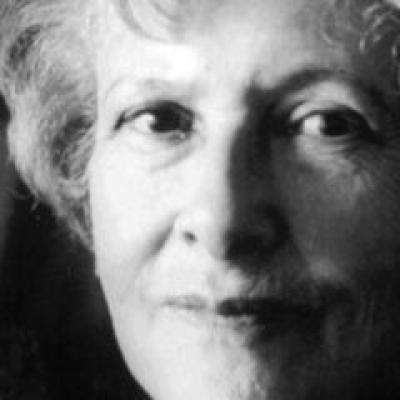
An absolute patience. Trees stand up to their knees in fog. The fog slowly flows uphill. White cobwebs, the grass leaning where deer have looked for apples. The woods from brook to where the top of the hill looks over the fog, send up not one bird. So absolute, it is no other than happiness itself, a breathing too quiet to hear.
I thought I was growing wings— it was a cocoon. I thought, now is the time to step into the fire— it was deep water. Eschatology is a word I learned as a child: the study of Last Things; facing my mirror—no longer young, the news—always of death, the dogs—rising from sleep and clamoring and howling, howling.... ("Seeing For a Moment")
I watch the clouds as I see them in pomp advancing, pursuing the fallen sun.
Do you mistake me? I am speaking of living, of moving from one moment into the next, and into the one after, breathing death in the spring air.
The threat of world's end is the old threat.
In certain ways writing is a form of prayer.
In city, in suburb, in forest, no way to stretch out the arms - so if you would grow, go straight up or deep down.
Rain-diamonds, this winter morning, embellish the tangle of unpruned pear-tree twigs; each solitaire, placed, it appears, with considered judgement, bears the light beneath the rifted clouds - the invisible shared out in endless abundance.
Don't eat those nice green dollars your wife gives you for breakfast.
You can live for years next door to a big pine tree, honored to have so venerable a neighbor, even when it sheds needles all over your flowers or wakes you, dropping big cones onto your deck at still of night.
Let me walk through the fields of paper touching with my wand dry stems and stunted butterflies.
Each part of speech a spark awaiting redemption, each a virtue, a power in abeyance.
slowly the pale dew-beads of light lapped up from flowers can thicken, darken to gold: honey of the human.
What joy when the insouciant armadillo glances at us and doesn't quicken his trotting across the track into the palm brush. What is this joy? That no animal falters, but knows what it must do?
I'm not very good at praying, but what I experience when I'm writing a poem is close to prayer.
Looking, Walking, Being, I look and look. Looking's a way of being: one becomes, sometimes, a pair of eyes walking. Walking wherever looking takes one. The eyes dig and burrow into the world. They touch, fanfare, howl, madrigal, clamor. World and the past of it, not only visible present, solid and shadow that looks at one looking. And language? Rhythms of echo and interruption? That's a way of breathing. breathing to sustain looking, walking and looking, through the world, in it.
A blind man. I can stare at him ashamed, shameless. Or does he know it? No, he is in a great solitude. O, strange joy, to gaze my fill at a stranger's face. No, my thirst is greater than before.
Teachers at all levels encourage the idea that you have to talk about things in order to understand them, because they wouldn't have jobs, otherwise. But it's phony, you know.
The artist must create himself or be born again.
Beespittle, droppings, hairs of beefur: all become honey. Virulent micro-organisms cannot survive in honey.
Breathe the sweetness that hovers in August.
Hypocrite women, how seldom we speak of our own doubts, while dubiously we mother man in his doubt!
Let the space under the first storey be dark, let the water lap the stone posts, and vivid green slime glimmer upon them; let a boat be kept there.
Affliction is more apt to suffocate the imagination than to stimulate it.
Yes, he is here in this open field, in sunlight, among the few young trees set out to modify the bare facts-- he's here, but only because we are here. When we go, he goes with us to be your hands that never do violence, your eyes that wonder, your lives that daily praise life by living it, by laughter. He is never alone here, never cold in the field of graves.
Insofar as poetry has a social function it is to awaken sleepers by other means than shock.
In June the bush we call alder was heavy, listless, its leaves studded with galls, growing wherever we didn't want it.
I like to find what's not found at once, but lies within something of another nature, in repose, distinct.
Marvelous Truth, confront us at every turn, in every guise.
Images split the truth in fractions.
There comes a time when only anger is love.
Wear scarlet! Tear the green lemons off the tree! I don't want to forget who I am, what has burned in me, and hang limp and clean, an empty dress -
Through the hollow globe, a ring of frayed rusty scrapiron, is it the sea that shines? Is it a road at the world's edge?
Writing poetry is a process of discovery...you can smell the poem before you see it....Like some animal.
Among a hundred windows shining dully in the vast side of greater-than-palace number such-and-such one burns these several years, each night as if the room within were aflame.
Praise the invisible sun burning beyond the white cold sky, giving us light and the chimney's shadow.
Two girls discover the secret of life in a sudden line of poetry.
The last cobwebs of fog in the black firtrees are flakes of white ash in the world's hearth.
The AvowalAs swimmers dareto lie face to the skyand water bears them,as hawks rest upon airand air sustains them;so would I learn to attain freefall, and floatinto Creator Spirit's deep embrace,knowing no effort earnsthat all-surrounding grace.
I'll dig in into my days, having come here to live, not to visit. Grey is the price of neighboring with eagles, of knowing a mountain's vast presence, seen or unseen.
The stairway is not a thing of gleaming strands a radiant evanescence for angels' feet that only glance in their tread, and need not touch the stone.
Both art and faith are dependent on imagination; both are ventures into the unknown.
Nothing we do has the quickness, the sureness, the deep intelligence living at peace would have.
In the dark I rest, unready for the light which dawns day after day, eager to be shared. Black silk, shelter me. I need more of the night before I open eyes and heart to illumination. I must still grow in the dark like a root not ready, not ready at all.
Prophetic utterance, like poetic utterance, transforms experience and moves the receiver to new attitudes. The kinds of experience--the recognitions or revelations--out of which both prophecy and poetry emerge, are such as to stir the prophet or poet to speech that may exceed their own known capacities; they are "inspired," they breathe in revelation and breathe out new words; and by so doing they transfer over to the listener or reader a parallel experience, a parallel intensity, which impels that person into new attitudes and new actions.
Days pass when I forget the mystery. Problems insoluble and problems offering their own ignored solutions jostle for my attention, they crowd its antechamber along with a host of diversions, my courtiers, wearing their colored clothes; caps and bells. And then once more the quiet mystery is present to me, the throng's clamor recedes: the mystery that there is anything, anything at all, let alone cosmos, joy, memory, everything, rather than void: and that, 0 Lord, Creator, Hallowed one, You still, hour by hour sustain it.
If woman is inconstant, good, I am faithful to ebb and flow, I fall in season and now is a time of ripening.
I don't think one can accurately measure the historical effectiveness of a poem; but one does know, of course, that books influence individuals; and individuals, although they are part of large economic and social processes, influence history. Every mass is after all made up of millions of individuals.
A poet articulating the dreads and horrors of our time is necessary in order to make readers understand what is happening, really understand it, not just know about it but feel it: and should be accompanied by a willingness on the part of those who write it to take additional action towards stopping the great miseries which they record.
The world is not with us enough. O taste and see.
What I heard was my whole self saying and singing what it knew: I can.
It is fatal to one's artistic life to talk about something that is in process.
So absolute, it is no other than happiness itself, a breathing too quiet to hear.
We must breathe time as fishes breathe water.
my pleasure was in the strength of my back, in my noble shoulders, the cool smooth flesh cylinders of my arms.
When you're really caught up in writing a poem, it can be a form of prayer. I'm not very good at praying, but what I experience when I'm writing a poem is close to prayer. I feel it in different degrees and not with every poem. But in certain ways writing is a form of prayer.
We have the words in our pockets, obscure directions. The old ones have taken away the light of their presence.
At Delphi I prayed to Apollo that he maintain in me the flame of the poem and I drank of the brackish spring there.
Mediocrity is perhaps due not so much to lack of imagination as to lack of faith in the imagination, lack of the capacity for this abandon.
One of the obligations of the writer is to say or sing all that he or she can, to deal with as much of the world as becomes possible to him or her in language.
Every day, every day I hear enough to fill a year of nights with wondering.
But for us the road unfurls itself, we don't stop walking, we know there is far to go.
I learn to affirm Truth's light at strange turns of the mind's road, wrong turns that lead over the border into wonder.
Mountain, mountain, mountain, marking time. Each nameless, wall beyond wall, wavering redefinition of horizon.
I believe every space and comma is a living part of the poem and has its function, just as every muscle and pore of the body has its function. And the way the lines are broken is a functioning part essential to the life of the poem.
Very few people really see things unless they've had someone in early life who made them look at things. And name them too. But the looking is primary, the focus.
The fire in leaf and grass so green it seems each summer the last summer.
blue bead on the wick, there's that in me that burns and chills, blackening my heart with its soot, I think sometimes not Apollo heard me but a different god.
Death and pain dominate this world, for though many are cured, they leave still weak, still tremulous, still knowing mortality has whispered to them; have seen in the folding of white bedspreads according to rule the starched pleats of a shroud.
There is no savor more sweet, more salt than to be glad to be what, woman, and who, myself, I am.
Grief is a hole you walk around in the daytime and at night you fall into it.
We are so many and many within themselves travel to far islands but no one asks for their story.
We call it "Nature"; only reluctantly admitting ourselves to be "Nature" too.
It's when we face for a moment the worst our kind can do, and shudder to know the taint in our own selves, that awe cracks the mind's shell and enters the heart.
There's in my mind a... turbulent moon-ridden girl or old woman, or both, dressed in opals and rags, feathers and torn taffeta, who knows strange songs but she is not kind.
And our dreams, with what frivolity we have pared them like toenails, clipped them like ends of split hair.
Peace as a positive condition of society, not merely as an interim between wars, is something so unknown that it casts no images on the mind's screen.
Love is a landscape the long mountains define but don't shut off from the unseeable distance.
The vast silence of Buddha overtakes and overrules the oncoming roar of tragic life that fills alleys and avenues; it blocks the way of pedicabs, police, convoys.
our nerve filaments twitch with its presence day and night, nothing we say has not the husky phlegm of it in the saying, nothing we do has the quickness, the sureness, the deep intelligence living at peace would have.
The poem has a social effect of some kind whether or not the poet wills it to have. It has a kenetic force, it sets in motion...elements in the reader that would otherwise remain stagnant.
You have come to the shore. There are no instructions.
But we have only begun to love the earth. We have only begun to imagine the fullness of life. How could we tire of hope?-so much is in bud.