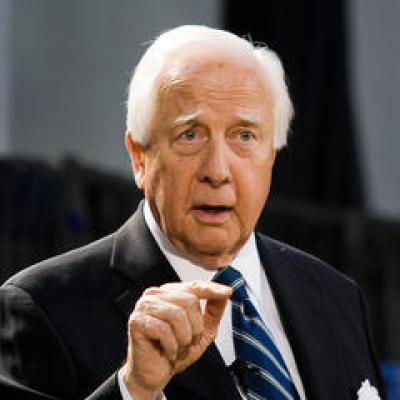
My wife, the star I steer by.
I would pay to do what I do if I had to.
With the Truman book, I wrote the entire account of his experiences in World War I before going over to Europe to follow his tracks in the war. When I got there, there was a certain satisfaction in finding I had it right - it does look like that.
The source of our suffering has been our timidity. We have been afraid to think....Let us dare to read, think, speak, write.
History is about life. It's awful when the life is squeezed out of it and there's no flavor left, no uncertainties, no horsing around. It always disturbed me how many biographers never gave their subjects a chance to eat. You can tell a lot about people by how they eat, what they eat, and what kind of table manners they have.
I think it is one of the most extraordinary elections, a turning point for our country and for the world. That remarkable young man [Barack Obama] has kept his demeanor, kept his temperament and has shown a power to inspire. I see what energy that he has inspired among the young. Well, it inspires us old goats too.
You can't learn to play the piano without playing the piano, you can't learn to write without writing, and, in many ways, you can't learn to think without thinking. Writing is thinking. To write well is to think clearly. That's why it's so hard.
I love to go to the places where things happen. I like to walk the walk and see how the light falls and what winter feels like.
Your education never stops and college is just the beginning. You come out of college with a huge advantage in that you've ideally and more times than not you've come out with a love of learning and that's what matters above all.
Nobody ever lived in the past.
Once I discovered the endless fascination of doing the research and of doing the writing, I knew I had found what I wanted to do in my life. Every book is a new journey. I never felt I was an expert on a subject as I embarked on a project.
I love all sides of the work but that doesn't mean it isn't hard.
A leader must look and act the part.
The fulfilling life, the distinctive life, the relevant life, is an achievement... To do whatever you do for no reason other than you love it and believe in its importance.
To hold the reader's attention, you have to bring the person who's reading the book inside the experience of the time: What was it like to have been alive then? What were these people like as human beings?
You have to have wisdom and knowledge as well as virtue to preserve your rights and liberties.
Each generation, we peel back biases that have blinded those before us. The more we know about the past enables us to ask richer and more provocative questions about who we are today.
There's an awful temptation to just keep on researching. There comes a point where you just have to stop, and start writing.
And read… read all the time… read as a matter of principle, as a matter of self-respect. Read as a nourishing staple of life.
Take the teacher not the course. Find out who the great professors are - the great teachers - and take their courses because a subject that you may not think you're interested in may turn out to be infinitely fascinating because of the way it's taught.
Find something to do that you love because then the work itself is always the reward not the recompense. And if you love what you're doing you probably do better at it than doing something you don't love and therefore you'll be compensated appropriately.
People often ask me if I'm working on a book. That's not how I feel. I feel like I work in a book. It's like putting myself under a spell. And this spell, if you will, is so real to me that if I have to leave my work for a few days, I have to work myself back into the spell when I come back. It's almost like hypnosis.
The truth isn't just the facts. You can have all the facts imaginable and miss the truth, just as you can have facts missing or some wrong, and reach the larger truth.
The past after all is only another name for someone else's present.
One of the regrets of my life is that I did not study Latin. I'm absolutely convinced, the more I understand these eighteenth-century people, that it was that grounding in Greek and Latin that gave them their sense of the classic virtues: the classic ideals of honor, virtue, the good society, and their historic examples of what they could try to live up to.
If you get down about the state of American culture, just remember there are still more public libraries in this country than there are McDonalds.
In time I began to understand that it's when you start writing that you really find out what you don't know and need to know.
Courage is contagious. If a leader shows courage, others get the idea.
We still dislike hypocrites. It's a very American characteristic. We still like people who have ideas and who are willing to stand up for what they believe in. We're very forgiving of failures and very willing to give people a second and third chance if they mean to do better and are sorry for what they've done.
Every book is a new journey. I never felt I was an expert on a subject as I embarked on a project.
People are so helpful. People will stop what they're doing to show you something, to walk with you through a section of the town, or explain how a suspension bridge really works.
With the situation as gray as it could be, no one was more conspicuous in his calm presence of mind than Washington. They must be "cool but determined" he had told the men before the battle, when spirits were high. Now, in the face of catastrophe, he was demonstrating what he meant by his own example. Whatever anger or torment or despair he felt, he kept to himself.
However little television you watch, watch less.
Home is really where education does begin.
No harm's done to history by making it something someone would want to read.
Read. Read every chance you get. Read to keep growing. Read history. Read poetry. Read for pure enjoyment. Read a book called Life on a Little Known Planet. It's about insects. It will make you feel better.
I feel that history is in many ways the most important of all subjects because it is about everything and because it's about who we are and how we came to be the way we are.
To shut yourself from history is to shut yourself off from say music or painting or the theatre, literature for the rest of your life. It would be to cheat yourself of the pleasures of life.
Never assume that people in positions of responsibility are behaving responsibly.
History isn't just what happened, but what happened to whom and why and what would have been different if the cast of characters had been different.
I think it's best to pick a biographical subject who lives to a ripe old age. Older people tend to relax and speak their minds. They're dropping some of the masks that they've been wearing. There's a candor.
If the attitude of the teacher toward the material is positive, enthusiastic, committed and excited, the students get that. If the teacher is bored, students get that and they get bored, quickly, instinctively.
There are people who are trying to write history for the general reader who can be quite tedious. That said, I do feel in my heart of hearts that if history isn't well written, it isn't going to be read, and if it isn't read it's going to die.
There is only one person who can measure your success. That person is you.
The year 1776, celebrated as the birth year of the nation and for the signing of the Declaration of Independence, was for those who carried the fight for independence forward a year of all-too-few victories, of sustained suffering, disease, hunger, desertion, cowardice, disillusionment, defeat, terrible discouragement, and fear, as they would never forget, but also of phenomenal courage and bedrock devotion to country, and that, too they would never forget.
The first of all qualities of a general is courage.
History is a guide to navigation in perilous times. History is who we are and why we are the way we are.
I'm absolutely positive it's in our human nature to want to know about the past. The two most popular movies of all time, while not historically accurate, are about core historic events: 'Gone With the Wind' and 'Titanic.'
Real success is finding your lifework in the work that you love.
In fact, it was the largest expeditionary force of the 18th century. The largest, most powerful force ever set forth from Britain or any nation.
He had kept his head, kept his health and his strength, bearing up under a weight of work and worry that only a few could have carried.
If we think back through our own lives, the subjects that you liked best in school almost certainly were taught by the teachers you liked best. And the teacher you liked best was the teacher who cared about the subject she taught.
If everyone is special, then no one is. If everyone gets a trophy, trophies become meaningless.
I often think of that when I hear people say that they haven't time to read.
I want people to see that all-important time in a different way-in the way it was. For of a number of reasons, including the absence of photographs, we tend to see the men and women of the Revolution as not quite real. And we have far too little sense of what they suffered.
The title always comes last. What I really work hard on is the beginning. Where do you begin? In what tone do you begin? I almost have to have a scene in my mind.
History is not just about dates and quotations. And it's not just about politics, the military and social issues, though much of it of course is about that. It's about everything. It's about life history. It's human. And we have to see it that way. We have to teach it that way. We have to read it that way. It's about art, music, literature, money, science, love - the human experience.
Exercise free will and creative, independent thought not for the satisfactions they will bring you, but for the good they will do others, the rest of the 6.8 billion–and those who will follow them. And then you too will discover the great and curious truth of the human experience is that selflessness is the best thing you can do for yourself. The sweetest joys of life, then, come only with the recognition that you’re not special. Because everyone is.
I work very hard on the writing, writing and rewriting and trying to weed out the lumber.
The evil of technology was not technology itself, Lindbergh came to see after the war, not in airplanes or the myriad contrivances of modern technical igenuity, but in the extent to which they can distance us from our better moral nature, or sense of personal accountability.
Curiosity is what separates us from the cabbages. It's accelerative. The more we know, the more we want to know.
We are raising a generation of young Americans who are, to a very large degree, historically illiterate. It's not their faults. There's no problem about enlisting their interest in history. None. The problem is the teachers so often have no history in their background.
Any nation that expects to be ignorant and free," Jefferson said, "expects what never was and never will be." And if the gap between the educated and the uneducated in America continues to grow as it is in our time, as fast as or faster than the gap between the rich and the poor, the gap between the educated and the uneducated is going to be of greater consequence and the more serious threat to our way of life. We must not, by any means, misunderstand that.
I lament the want of a liberal education. I feel the mist of ignorance to surround me - Nathanael Greene
Let the children have their night of fun and laughter. Let the gifts of Father Christmas delight their play. Let us grown-ups share to the full in their unstinted pleasures before we turn again to the stern task and the formidable years that lie before us, resolved that, by our sacrifice and daring, these same children shall not be robbed of their inheritance or denied their right to live in a free and decent world." Winston Churchill Christmas Eve Message, 1941 as printed in "In the Dark Streets Shineth.
We should draw on our story, we should draw on our history. If we don't know who we are, if we don't know how we became what we are, we're going to start suffering from all the obvious detrimental effects of amnesia.
There's no such thing as a foreseeable future.
I think that a good education ought to be in part the idea that ease and joy are not synonymous. Some of the most fulfilling pleasures of life are to be found in work - found in work you love to do, work you want to do, work that makes you want to get out of bed in the morning.
Love of learning will never let you down. You can have a quest for money, you can have a quest for power, you can have a quest for fame and they are sometimes gratifying and sometimes self-destructive. The love of learning is always gratifying and never self-destructive. The more educated, the more cultivated a society becomes, better off is everybody.
The pull, the attraction of history, is in our human nature. What makes us tick? Why do we do what we do? How much is luck the deciding factor?
I think that we need history as much as we need bread or water or love.
My strong feeling is that we must learn more about how we learn. I'm convinced that we learn by struggling to find the solution to a problem on our own with some guidance, but getting in and getting our hands dirty and working it.
The great thing about the arts is that you can only learn to do it by doing it.
Since September 11, it seems to me that never in our lifetime, except possibly in the early stages of World War II, has it been clearer that we have as a source of strength, a source of direction, a source of inspiration - our story.
I can fairly be called an amateur because I do what I do, in the original sense of the word - for love, because I love it. On the other hand, I think that those of us who make our living writing history can also be called true professionals.
I feel very strongly that history is about everything. It isn't just about politics or the military or social issues. If art, music, engineering, science, medicine, finance, the world of architecture and technology - if those are left out, then you're not getting a full sense of the human condition. History is human and we human beings are involved in all kinds of things and that's part of our humanity.
It was a day and age that saw no reason why one could not learn whatever was required - learn vitally anything - by the close study of books.
You can make the argument that there's no such thing as the past. Nobody lived in the past. They lived in the present. It is their present, not our present, and they don't know how it's going to come out. They weren't just like we are because they lived in that very different time. You can't understand them if you don't understand how they perceived reality.
Nothing ever invented can you a bigger life than a book.
There is a human longing to go back to other times. We all know how when we were children we asked our parents, "What was it like when you were a kid?" I think it probably has something to do with our survival as a species.
On Christmas morning when I was a child, my mother would leave a book wrapped at the foot of the bed, which was a hint that Santa had come. It was also her way of keeping us in bed a little longer before we went downstairs. So I've always associated books with happiness and gifts. And they are. I can't get enough of them.
I feel that what I do is a calling. I would pay to do what I do if I had to. I will never live long enough to do the work I want to do: the books I would like to write, the ideas I would like to explore.
You can't love what you don't know much about. You can't convince, stimulate, hold the attention, teach, if you don't know what you're talking about.
The talent, including the talent for history - and I do think there are people who just have a talent for it, the way you have a talent for public speaking or music or whatever - it shouldn't be allowed to lie dormant. It should be brought alive.
I think the public library system is one of the most amazing American institutions. Free for everybody. If you ever get the blues about the status of American culture there are still more public libraries than there are McDonald's. During the worst of the Depression not one public library closed their doors.
When a friend of Abigail and John Adams was killed at Bunker Hill, Abigail's response was to write a letter to her husband and include these words, "My bursting heart must find vent at my pen.
The more Adams thought about the future of his country, the more convinced he became that it rested on education. Before any great things are accomplished, he wrote to a correspondent, a memorable change must be made in the system of education and knowledge must become so general as to raise the lower ranks of society nearer to the higher. The education of a nation instead of being confined to a few schools and universities for the instruction of the few, must become the national care and expense for the formation of the many.
We are all what we are, in large degree, because of others who have helped, coached, taught, counseled, who set a standard by example, who've taken an interest in our interests, opened doors, opened our minds, helped us see, who gave encouragement when we needed it, who reprimanded or prodded when we needed it, and at critical moments, inspired.
A nation that forgets its past can function no better than an individual with amnesia.
It was an utterly phenomenal achievement.
Develop and protect a moral sensibility and demonstrate the character to apply it. Dream big. Work hard. Think for yourself. Love everything you love, everyone you love, with all your might. And do so, please, with a sense of urgency, for every tick of the clock subtracts from fewer and fewer...
I could not do what I do without the kindness, consideration, resourcefulness and work of librarians, particularly in public libraries... What started me writing history happened because of some curiosity that I had about some photographs I'd seen in the Library of Congress.
May none but honest and wise men ever rule under this roof.
I am adamant that we must not cut back on funding of the teaching of the arts in the schools: music, painting, theater, dance, all of it. The great thing about the arts is that the only way you learn how to do it is by doing it.
Spotting talent is one of the essential elements of great leadership.
Washington was a man of exceptional, almost excessive self-command, rarely permitting himself any show of discouragement or despair.
Only those who [do] nothing [make] no mistakes.
Unlike the people you see in Mathew Brady's photographs from the Civil War, the men and women of the Revolution seem more like characters in a costume pageant. And it's a pageant in which the performers are all handsome as stage actors, with uniforms and dress that are always costume perfect.
Climb the mountain so you can see the world, not so the world can see you.
History is not the story of heroes entirely. It is often the story of cruelty and injustice and shortsightedness. There are monsters, there is evil, there is betrayal. That's why people should read Shakespeare and Dickens as well as history ~~ they will find the best, the worst, the height of noble attainment and the depths of depravity.
Real success is finding your life work in the work that you love. That's it. Don't worry about making a living, don't worry about popularity or fame. Make what you do ... count more than what you own.
I think it's important to remember that these men are not perfect. If they were marble gods, what they did wouldn't be so admirable. The more we see the founders as humans the more we can understand them.
One of the things about the arts that is so important is that in the arts you discover the only way to learn how to do it is by doing it. You can't write by reading a book about it. The only way to learn how to write a book is to sit down and try to write a book
When the founders wrote about life, liberty, and the pursuit of happiness, they didn't mean longer vacations and more comfortable hammocks. They meant the pursuit of learning. The pursuit of improvement and excellence. In hard work is happiness.
Writing is thinking. To write well is to think clearly. That's why it's so hard.
I've always been dissatisfied, I know that. But lately I find that I reek of discontentment. It fills my throat, and it floods my brain. And sometimes I fear there is no longer a dream, but only the discontentment.
Why limit yourself to the experience of your own relatively brief time on earth, according to your biological clock, when the whole realm of the human experience reaching back infinitely far is available to you?
My love is to tell a story but I like stories that evolve from character, from the nature of the individuals involved.
We all know the old expression, "I'll work my thoughts out on paper." There's something about the pen that focuses the brain in a way that nothing else does. That is why we must have more writing in the schools, more writing in all subjects, not just in English classes.
It would be the most crucial day of the entire war.
I had been writing for about twelve years. I knew pretty well how you could find things out, but I had never been trained in an academic way how to go about the research.
I love Dickens. I love the way he sets a scene.
The most interesting people are never perfect.
I don't pick my presidents because they were great presidents. I'm not much interested in ranking presidents and who is the best and who is the worst. I am much more inclined to be interested in them if they had an interesting life and if they were a complete person - and by that I mean they also had flaws and failings.
You've got to marinate your head, in that time and culture. You've got to become them." (Speaking about researching, and reading, and immersing yourself in History)
To me history ought to be a source of pleasure. It isn't just part of our civic responsibility. To me it's an enlargement of the experience of being alive, just the way literature or art or music is.
I just thank my father and mother, my lucky stars, that I had the advantage of an education in the humanities.
First of all, you can make the argument that there's no such thing as the past. Nobody lived in the past.
How can we know who we are and where we are going if we don't know anything about where we have come from and what we have been through, the courage shown, the costs paid, to be where we are?
Nothing ever invented provides such sustenance, such infinite reward for time spent, as a good book.
Books can change your life. Some of the most influential people in our lives are characters we meet in books.
Our obligations to our country never cease but with our lives. - John Adams
You can't be a full participant in our democracy if you don't know our history.
Morality only is eternal. All the rest is balloon and bubble from the cradle to the grave.
My shorthand answer is that I try to write the kind of book that I would like to read. If I can make it clear and interesting and compelling to me, then I hope maybe it will be for the reader.