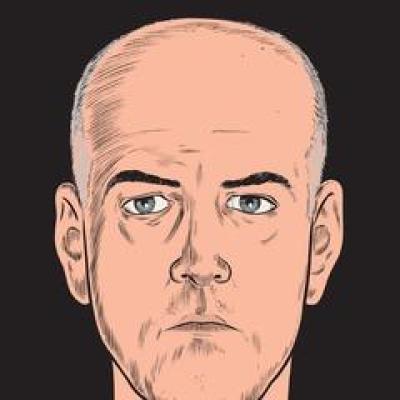
I'd always wanted to do a weekly strip, or a strip that was in installments like that. It's been fun trying to figure out how to make that work. Their standards are so prissy that they won't allow me to use all kinds of language. Not only can you not swear, this morning I was informed I couldn't use the word "schmuck." I couldn't use "crap," "schmuck," or "get laid." Those three were beyond the pale. But you get around that, and it comes out better. I can't quite explain why.
You try to make the world a better place and what does it get you? I mean, Christ, how the hell does one man stand a chance against four billion assholes?
In some ways, I never outgrew my adolescence. I wake up in the morning and think, 'Oh my God, I'm late for a math test!' But then I say, 'Wait a minute. I'm 40.
You need to be, like, turning down high-paying illustration work because you want to work on your comic. That's when you know you're doing something good.
As soon as I'm finished with it, it feels like an impersonal project. Like, "Well, I did another book."
I think that gulf is what makes the work interesting, but as a creator it's endlessly frustrating because I'm starting out with this goal, this thing I'm trying to create, and then the thing I actually do create is very, very different. It's always painful, in some ways, especially when it's just finished.
Writing a screenplay, I'm like, "All I'm responsible for is that final script, and I take great effort and pride in that." But once I give it to someone to make, I can disassociate with it entirely and not worry that my vision isn't being represented, because I understand fully that that's not how it works.
I see a lot of possibilities in the age of my characters - between 18 and 21. You have a window of opportunity when you leave your childhood behind and have this chance to become what you always wanted to be. For me, that was a time when I could have gone many different ways. I was in flux and deciding what kind of person I would become. There's something interesting about the vision of what that will be and the reality of making that happen, and how you really are what you are. Unless you're "in character," it's impossible to get around that.
Everybody just lets the media do their thinking for them... that's why you'll never hear any reggae on the radio!
I was thinking the other day that there will never be another form of music that everybody has to respond to - like disco.
I'm always hiding the books in my closet, and my art's always turned upside down in my drawer.
I'm more interested in characters who are a little difficult.
I feel like a lot of my aesthetic was in response to feeling the awfulness and cheapness of that [ the 70'th].
I was 30 before I made a living that was not embarrassing.
I try personally not to be nostalgic.
There are certain things in there that no one else would recognize, really. I see details of my life that I didn't even intend to put in when I was doing the work. For example, I noticed that every single kid in the high school in The Death-Ray is based on somebody I went to high school with.
Avatar is a total nerd thing, and yet our popular culture has somehow made all that stuff acceptable.
But I enjoy the opportunity to use swear symbols.
I just try to make comics for myself, try to give it some kind of unity throughout. That often involves tiny details. I'm never sure what's going to be obvious or what nobody will ever notice. I put stuff in my comics that I thought was blatantly obvious, and nobody noticed. And things that I think are buried in the background, everybody gets it. So I try to be consistently aware of every part of the frame.
I think I've had the fantasy of a ray-gun that could erase the world from the time I was a very little kid.
Face it, you hate every single boy on the face of the Earth!" "That's not TRUE, I just hate all these obnoxious, extroverted, pseudo-bohemian art-school losers
I never feel there's anything I can't do with comics. There are certain things in comics that you can't do in any other medium: for instance, in Mister Wonderful, Marshall's narration overlaps the events as they're going on. That would be difficult in film; you could blot speech out with a voiceover, but it wouldn't have the same effect. That's always of interest, to see what new things you can do in comics form.
Usually when I put together a book like this Death-Ray hardcover or that Ghost World special edition, then I have to reread it and see if there is anything I want to change or any re-coloring I want to do. That's when I'm faced with the actual work. When I'm working, I'm too close to it. I'm sort of inside, and I can't see it at all. So when I have that experience of rereading it years later, it's jarring.
In an art school it's very hard to tell who is the best.
I never know if a book is crazy or not. There's that fear - this is the one that will end it all.
But they always just laugh off everything I say, when really I want absolutely nothing more than to destroy the world they live in and to watch them suffer, alone and miserable, trying to live in my world for a change!
That's been my main interest for the last 15 years, is to really make sure the story and the characters take precedence over everything else, and that I give them everything I can to make them exist as actual people.
I've had a real lucky time working in Hollywood. I've talked to other screenwriters, and they're all kind of beaten down and their spirits are crushed, because they work on these screenplays and these projects, and then directors either take them and change everything, rewrite them and make them worse, or they film them and they're nothing like how they imagined it to be.
The trouble is the kind of guy I want to go out with doesn't even exist... Like a rugged, chain-smoking, intellectual, adventurer guy who's really serious, but also really funny and mean.
My feeling is that it's one of the very few things that comics can do that you really can't do in any other medium. I feel like the reader accepts all of these styles, and after a certain point you can flip the pages and see a character rendered very differently than you saw on an earlier page, and it's not jarring. It suggests things that you can't suggest just in the writing or in the plotting.
I tend to be the type who is overly polite and sort of ingratiating to other people.
When you see somebody who's got a complaining personality, it usually means that they had some vision of what things could be, and they're constantly disappointed by that. I think that would be the camp that I would fall into - constantly horrified by the things people do.
You have to find the tone of the piece and modulate that. There are ways to indicate that - I try to incorporate the biggest range I can within the story, going from humorous to serious without it being jarring. That's the hardest part, to keep that balance. It requires being constantly aware of where you are in the story. You can't really do that in a movie: You can't slightly modulate the tone by the way the character's eyeballs look in one certain scene.
I think that's what we're all most terrified about: that we'll just die and disappear and we'll leave no trace.
I'm a fan of parchment and wood pulp.
I think if you had different artists approaching the material in different styles, that's very different. I think it's an interesting thing to discover, what's present in the work even when you're shifting the styles. I've just found it a much stronger way to work.
For example, I noticed that every single kid in the high school in 'The Death-Ray' is based on somebody I went to high school with.
I knew how to draw all of the different smokestacks on the old trains and all that stuff, and then I realized that if I can draw trains, which is the thing I was probably the least interested in in the world at the time, I can do anything and find a way into it that will be interesting.
Comics seldom move me the way I would be moved by a novel or movie.
If you think about it enough to have a really articulate answer, you're not doing it right. That's how I feel about art. If your thought process could take you to knowing exactly what you're doing and why, there would be no point in making the art. It would become like propaganda. It's more nebulous than that.
I have a very low tolerance for animation. I'm used to the perfect integrity you get from drawing your own comics. There's something about that that animation always loses.
I've felt that in the past, where I just felt like I had to keep drawing in the same way to maintain this sameness and rhythm throughout an entire book, and it was not really necessary.
Comics seldom move me the way I would be moved by a novel or movie. I say this as someone who would rather read comics than watch movies, listen to music, anything. But it's not an operatic medium. I hear other people talk about being moved to tears by comics. I can't imagine that.
It's embarrassing to be involved in the same business as the mainstream comic thing. It's still very embarrassing to tell other adults that I draw comic books - their instant, preconceived notions of what that means.
I think a comic looks better in the magazine. The colors are designed to be on paper, not illuminated on screen. I don't like the aspect of people reading it for free. When people get things for free, they tend to not take them as seriously. But I don't know. I'm sure 10 times more people are reading it online than in the actual paper.
I love the medium and I love individual comics, but the business is nothing I would be proud of.
I used to use cigarettes to indicate somebody's an outsider a lot. It gave character a seedy, disreputable, almost suicidal quality. Now cigarettes are so unused - - you can't have anybody indoors smoking. If you drew that in a restaurant, you'd have to have a panel where the manager comes over and kicks them out. Unless it's set in Europe, you can't really do that. Characters who smoke - - it dates comics, somehow.
I lose faith in everything else, but rarely in my work. If I start to get bored, I change it to make it more interesting. I try not to take it too seriously, but I also try to never cheat or hurry things along.
Even if I only had 10 readers, I'd rather do the book for them than for a million readers online.
I don't read much of anything online.
The secret to being alone is to organize your time; to develop habits and routines and gradually elevate their importance to where they seem almost like normal, healthy activities.
I can look at my early work and see what a pained struggle it was to draw what I was drawing. I was trying so hard to get this specific look that was in my head, and always falling short.
Writing screenplays is very freeing from what you can do in comics in a lot of ways. You can change things around. I can take great delight in writing 40 pages, then just pressing delete and getting rid of it and not thinking about it ever again. Whereas in comics, if I had put that kind of effort into it, I couldn't go on.
Though to the average person that you'll meet on an airplane, if you tell them you draw comics, they'll still have sort of the same response - not like that's seeped into the culture at large, that comics are not just for kids.
It's a challenge to express real life in dramatic terms. In an entirely "made-up" story, you are sometimes overwhelmed by the infinite possibilities.
I really want people to read the book, and bookstores never sold an issue of Eightball because nobody knew what it was.
Something I always wanted to do, to capture that later half of the '70s. It's like the early half of the '70s is still the '60s, in that there's still kind of a playfulness and inventiveness in terms of design and the things that were going on in the culture. The second half, it got much more commodified. It's possibly the ugliest era of architecture and clothes and design in the entire 20th century, from 1975 to '81 or '82.
When I go back and reread the stuff, I'm always floored by how deeply personal and revealing it actually is.
All I can say on the Guilford story - and this comes more from my perspective as a father than an artist - is for parents and administrators to give so little value to the career of a public-school teacher - to allow him to be cast aside without exhausting every avenue to resolve the issue - is an obscenity worse than anything I've ever drawn in my comics.
One of my weekend hobbies is to go look at old houses when there are open houses around here. Just to go look at the architecture. And you can see how many houses were built around 1977, the year where everyone said, "Let's put in these aluminum windows instead of beautiful hand-made wood ones."
I originally just wanted to be an artist.
I was a very fearful little kid, and I would always see the worst in everything. The glass was half-empty. I would see people kissing, and I would think one was trying to bite the other.
I think politics has an influence on my work now, perhaps more so than when I was a childless young man, but I hope never to deal with these kinds of issues in anything more than a covert manner. I'm more interested in figuring out what I think than in pronouncing my views to the world.
I enjoy the opportunity to use swear symbols. The reader reads into them something worse than what you normally would have. They work as this outburst of incoherent anger. I've found ways to write around swearing that are much more effective, rather than going for what someone really would say.
It's hard to tell if anyone's interested in reading a serialized story. But it's interesting to put in a cliffhanger each week. That was popular in old comic strips. They'd write a weekend story different from the daily strip. So people follow one story day to day, and a separate story on weekends. If you read them, you think "I'll read two more." Then you're like "I gotta find out!" And you read 500 more.
I have cultivated a little crew of people whose opinions I understand. It's like the way you'd follow certain film critics because you know what their criteria are, and you may not agree with them, but you can glean from their opinion how you will feel about a film.
More and more, I tried to make comics in the way I like to read comics, and I found that when I read comics that are really densely packed with text, it may be rewarding when I finally do sit down and read it, but it never is going to be the first I'm going to read, and I never am fully excited to just sit down and read that comic.
I'm not opposed to comics on the Internet. It's just not interesting to me.
I'm always looking for things I imagine must exist, but don't - this is usually the impetus to create that thing myself.
I try to only work on the screenplays for a few hours a day when I'm in my most voluble mood, just sort of writing whatever comes into my head. It's a very freeing thing.
There are certain comics that just seem like they have this perfect balance between dialogue and image that I can't not read. I'll want to save it for later, and the next thing I know, I'm reading it. That's what I'm kind of trying to do with my comics.
I never feel there's anything I can't do.
Often I'll do research just to get a time period correct, but I didn't have to for the '70s... I feel like I can close my eyes and still see it so clearly.
I had no television when I was little, just a stack of old, beat-up comics from the 1950s and 1960s.
Surely comics require more effort on the part of the reader than movies or television. I'm always learning new things you can do with comics that wouldn't work in any other medium, and often they require the need to process a lot of dense information. Of course, the trick is to make the complicated seem effortless and spontaneous.
Before I could read, I remember trying to piece together the stories from the images. It was a very primal experience.
In a movie, you have to be mindful that no budget is going to be able to deal with running around the globe at every whim of the writer.
I'm usually the last to see my influence in other people's work. People give me stuff and say "Oh look, this guy's ripping you off," and I'm like "What do you mean?" Often I see the people that I've ripped off filtered into my own work. In other people's work, I can only see specific, tiny little instances of inflections stolen from another artist.
It keeps me moving when I see people doing stuff that I see as "my" direction. I think, "Oh, it's been tainted. Now I've got to do something new." There's nothing worse than working on your own stuff and thinking that someone else is following you along.
I think I'm gonna attach myself to the sinking ship that is book publishing.
I believe in the transformative power of cinema. It is only through this shared dream-experience that we can transcend the oppressive minutiae of daily existence and find some spiritual connection in the deeper reality of our mutual desire.
I feel like I understood the language of comics. I had a real fluidity with that medium at a very early age.
I think there was a point that I realized I could do what I wanted to do in terms of the drawing. I used to run around a lot of things. I would shy away from certain things that I realized would be horrible for me to draw, and just wouldn't be fun.
You can give some kind of spark of life to a comic that a photograph doesn't really have. A photograph, even if it's connecting with you, it seems very dead on the page sometimes.
The greatest moment of my life was, somebody sent me a cable-access show from Chicago that had Joey Ramone on it showing the video we made together. And he was talking about, like, "This guy Dan Clowes postponed his wedding for us. He's a great guy."
I think I have a very clear vision of what I want things to look like.
Certainly it's great to be able to talk to your friends about something. They might mention a film, and you can find all about it, and you don't have to wait months until you can find a book that might cover the subject and keep it in your head. You can have that kind of immediacy. But there's also something about it, where all the knowledge seems kind of fleeting. All the stuff I learn about in that way, I can be interested in for a day and then it's gone.
Film is a director's medium, and a film set is a complicated military structure - I have to keep reminding myself to stay in my place, or all will burst into chaos.
I try to employ a different strategy for each story. Often, I'll have a specific look in mind before I even have the story to go with it. I'm not so much interested in forcing the issue of reader identification through various graphic tricks. I'm more interested in creating specific characters that resonate with my own particular inner struggles.
For me, the whole process involves envisioning this Ghost World comic book in my head as I'm working.
At a certain point, I realized that I could draw anything, and there was nothing I should avoid - I could make it work. That's opened me up to being able to be much more comfortable telling any kind of story.
Alfred Hitchcock talked about planning out his movies so meticulously that when he was actually shooting and editing, it was the most boring thing in the world. But drawing comics isn't like shooting a movie. You can shoot a movie in a few days and be done with it, but drawing a comic takes years and years... That's the biggest part of doing comics: You have to create stuff that makes you want to get out of bed every morning and get to work.
I must have been 3 years old or less, and I remember paging through these comics, trying to figure out the stories. I couldn't read the words, so I made up my own stories.
I started drawing at a very young age. Writing a story wasn't satisfying, but to actually draw our own world - it's like controlling your own dreams.
If I could have somehow been the kind of artist who could crank out two or three issues a year, that's different. That's sort of what it's all about, to get this thing out so that there's some kind of continuity. But to do a comic book every year or two was just so anti-climactic.
I have this certain vision of the way I want my comics to look; this sort of photographic realism, but with a certain abstraction that comics can give. It's kind of a fine line.
I actually start drawing things. Usually they're abandoned before I commit too much time and effort.
I like to leave a little room to innovate and change things around while I'm working.
It's much more liberating as a artist to feel like you can approach each page and each panel with the way that inspires you the most. I think the thing that bogs down a lot of artists is that you're kind of stuck drawing in a style you've developed.