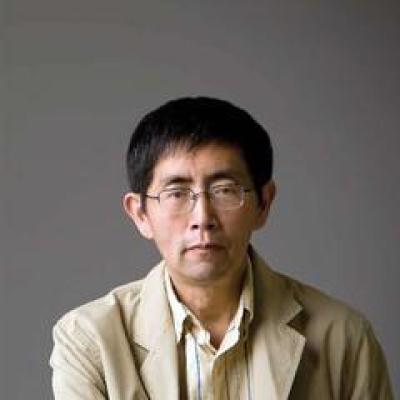
Writing is the thing that sustains me and keeps me going. It is a form of self-preservation for me.
I don't think of writing my poems for China or for the world. I mainly think of a small audience of friends and people I know. I am writing for that small group. They are not necessarily going to be able to read it, but that's what I have in mind when I write.
Bei Dao became the most well-known name for me because of certain criticism of my work. Bei Dao was the name under which my work was criticized. So I became more well-known under Bei Dao than under the other names.
The name Bei Dao was actually given to me with the help of friends. When we were publishing our unofficial magazine, Today, we wanted to avoid being harassed by the police so we were trying to think of names that we could use. It was done very casually.
On the one hand poetry is useless. It can't change the world materially. On the other hand it is a basic part of human existence. It came into the world when humans did. It's what makes human beings human.
Perhaps the final hour is come I have left no testament Only a pen, for my mother I am no hero in an age without heroes I just want to be a man.
As a writer, the most important thing for me is to continue to write, no matter where I am.
Freedom is nothing but the distance between the hunter and the hunted.
Being a poet in the States is quite different from being one in China, because in the States poetry depends on the universities for its support. They finance the poets and help them get published. That isn't so in China. But overall it is the same. You can't change society with poetry.
In the world I am Always a stranger I do not understand its language It does not understand my silence
Author details
Bei Dao: Biography and Life Work
Bei Dao was a notable Poet. The story of Bei Dao began on August 2, 1949 in Beijing, China.
Bei Dao ( simplified Chinese : 北岛 ; traditional Chinese : 北島 ; pinyin : Běi Dǎo ; lit. 'Northern Island', born August 2, 1949) is the pen name of the Chinese-American writer Zhao Zhenkai ( simplified Chinese : 赵振开 ; traditional Chinese : 趙振開 ; pinyin : Zhào Zhènkāi ). Among the most acclaimed Chinese-language poets of his generation, he is often regarded as a candidate for the Nobel Prize in Literature . In addition to poetry, he is the author of short fiction, essays, and a memoir. Known as a dissident, he is a prominent representative of a school of poetry known variously in the West as "Misty" or "Obscure" Poetry .
Philosophical Views and Reflections
Stranded in Europe, Bei Dao moved from one country to another. After his term as a visiting writer in West Berlin, he spent much of 1990 in Scandinavia , where, in Oslo , he and fellow exiles decided to revive Jintian as an émigré journal. His forced exile garnered global media attention as well as increased interest in his work. For example, in addition to invitations to speak at international literary conferences, two collections of his work appeared in the United States simultaneously: a poetry collection, The August Sleepwalker , and a fiction collection, Waves . Writing in The New York Times Book Review , the sinologist Jonathan Spence praised the books as "powerful" and "astonishing and beautiful". In 1991, Bei Dao relocated to Paris , where he lived on Rue de Venise, across from the Pompidou Center . Another poetry collection, Old Snow , appeared in English that year.
In addition, two books published in English have collected previously published material: At the Sky's Edge (1996) is a re-issue of both Forms of Distance and Landscape Over Zero , and Endure (2011) collects new translations of previously available work.